
Wednesday, January 16, 2013
Tuesday, January 15, 2013
Facebook charges you $100 to post to people they term important

This has interesting implications for journalism. In a world when Thomas Friedman gets speaking gigs for $50,000 a day, now a news source has to pay the reporter $100 just to submit a tip.


Friday, January 11, 2013

Tuesday, January 08, 2013
The Tide has turned, the game is won, yet a ticket seller is advertising Notre Dame as victor

Just now advertised on Facebook. I write this at 6:27 AM on January 8, 2013. TicketsNow is bragging that Notre Dame will win the national championship in NCAA football. The only problem is, Alabama won the game last night.
Things I wonder:
- How much is TicketsNow paying to advertise a game that has already been played?
- Why would a ticket vendor pick a team as a favorite? Isn't their goal to sell tickets, not pick winners?
- Having spent money advertising tickets for a game that has already been played, and cheering for a team that lost decidedly, what will the marketing manager for TicketsNow choose as his next line of work?
- Why would a ticket vendor pick a team as a favorite? Isn't their goal to sell tickets, not pick winners?
- Having spent money advertising tickets for a game that has already been played, and cheering for a team that lost decidedly, what will the marketing manager for TicketsNow choose as his next line of work?
Friday, January 04, 2013

Wednesday, November 28, 2012

Monday, August 06, 2012
Facebook continues to threaten me with censorship
So I enter into the discussion about Harry Reid and Romney's taxes. To the uninformed eye, my position is a tad complicated: I think Romney should make public his taxes, as his dad, George Romney, did in the 1960s.
I also think Harry Reid is acting like McCartney in saying he "heard someone say that maybe Romney didn't pay taxes the last many years."
So I try to post this view on Facebook, and once again, their robot accuses me of spam.
Facebook has a bot that confuses discourse with discussion.
I also think Harry Reid is acting like McCartney in saying he "heard someone say that maybe Romney didn't pay taxes the last many years."
So I try to post this view on Facebook, and once again, their robot accuses me of spam.
Facebook has a bot that confuses discourse with discussion.
Monday, March 05, 2012
CBS News claims Hedy Lamarr invented Wi-Fi
CBS News reports about a book about the 40s actress Hedy Lamarr under a headline claiming that she invented Wi-Fi. (They misspelled the term as "WiFi", by the way.)
There is credible evidence that Lamarr came up with the notion of frequency hopping. Clever idea that has nothing to do with Wi-Fi. In fact, the original incarnation of Wi-Fi shared spectrum with microwave ovens and home cordless phones. My wife could jam my Wi-Fi connection by warming coffee or making a phone call. IEEE 802.11b was very susceptible to interference.
Claiming Hedy Lamarr invented Wi-Fi is a nice glamorization. She conceived frequency hopping, for which she deserves due credit. She did not invent Wi-Fi. Even Isaac Newton said he stood on the shoulders of giants.

There is credible evidence that Lamarr came up with the notion of frequency hopping. Clever idea that has nothing to do with Wi-Fi. In fact, the original incarnation of Wi-Fi shared spectrum with microwave ovens and home cordless phones. My wife could jam my Wi-Fi connection by warming coffee or making a phone call. IEEE 802.11b was very susceptible to interference.
Claiming Hedy Lamarr invented Wi-Fi is a nice glamorization. She conceived frequency hopping, for which she deserves due credit. She did not invent Wi-Fi. Even Isaac Newton said he stood on the shoulders of giants.

Tuesday, February 28, 2012
Nice surprise birthday card
A Facebook friend was kind enough to take a Wall photo of mine and turn it into a birthday card. I thought that was a nice thing to do.


Saturday, February 25, 2012
QR codes are for physical objects...
Not Web pages. It adds no value to slap a QR code on a Web page or resource that could be a hyperlink.


A QR code is, at root, a 2 dimensional bar code. It can be useful if someone is in sight of a physical object where it is more efficient to scan some quick info in, assuming your consumer of info has a QR decoder handy on a smartphone with camera.
But people are using QR codes as if they are the latest thing in social media. It is an updated bar code from the 1990s. It is intended to be something you use a handheld device to read when processing, say, the handling of a piece of equipment moving on an assembly line. If you think you are a way cool 21st century Web consultant and are encouraging your customer to use QR codes, welcome to 1994 and the label on your delivery package.
Hint: Don't publish a QR code if your reader is online and could just click on a hyperlink.
Hint number 2: Don't forget the power of a simple URL.
But people are using QR codes as if they are the latest thing in social media. It is an updated bar code from the 1990s. It is intended to be something you use a handheld device to read when processing, say, the handling of a piece of equipment moving on an assembly line. If you think you are a way cool 21st century Web consultant and are encouraging your customer to use QR codes, welcome to 1994 and the label on your delivery package.
Hint: Don't publish a QR code if your reader is online and could just click on a hyperlink.
Hint number 2: Don't forget the power of a simple URL.
Friday, February 17, 2012
WZZM Grand Rapids presents questionable spelling feature
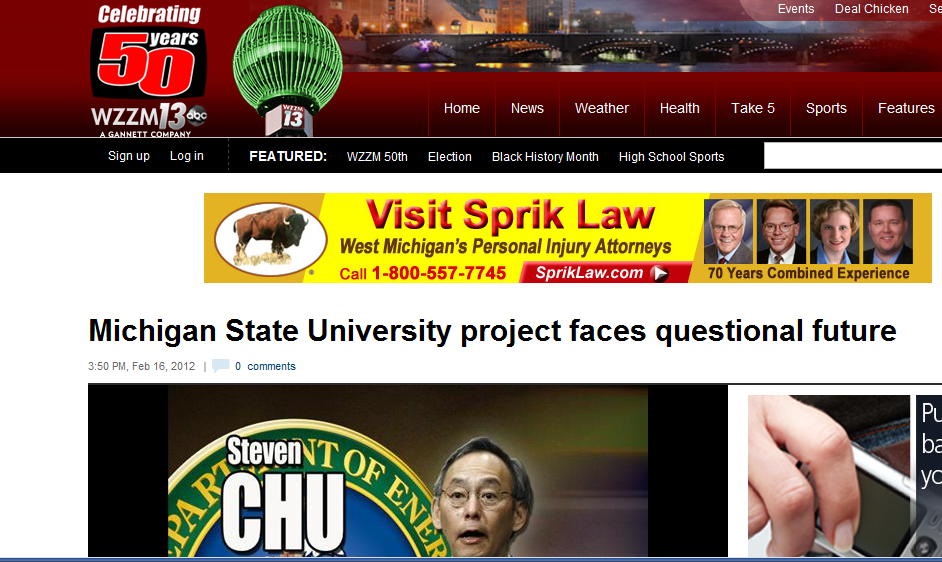
Questional??? Well you are a Gannett media outlet.
Sunday, October 02, 2011
Michigan State event: "Relics of the Big Bank"
I saw this event title on the MSU events calendar:
"Relics of the Big Bank"
Hmm, sounds like it might be interesting, in light of the recent banking and financial crisis. Maybe it also covers historical context, such as previous bank failures, in the Great Depression and in previous financial panics.
Actually it's about the Big Bang, not the Big Bank. It's MSU's Physics-Astronomy department, an event at the MSU Planetarium.
A big university covers many areas of inquiry...

"Relics of the Big Bank"
Hmm, sounds like it might be interesting, in light of the recent banking and financial crisis. Maybe it also covers historical context, such as previous bank failures, in the Great Depression and in previous financial panics.
Actually it's about the Big Bang, not the Big Bank. It's MSU's Physics-Astronomy department, an event at the MSU Planetarium.
A big university covers many areas of inquiry...

Monday, September 26, 2011
"Google Junior" - How Long Before Google Smites this?
Ran into this site advertised on Facebook today. It's a Google ripoff in every way: cops the classic Google look, uses Google Custom Search. And it doesn't appear to achieve its goal of being child proof. (Then again, I once heard that a packaging prof at Michigan State tested child proof packaging, and found that off all age groups, children were best at opening child proof packaging.)


Friday, September 23, 2011
When My Mom Was Certain Skylab Would Fall to Earth and Hit Me
My friend Don Richter pinged me today about how my mother feared that America's first space station would smite me.
My dad was a NASA engineer. He did important work testing the Saturn V rocket, but I think the proudest part of his career was working with others on the design of Skylab, the first space station. He got to work with astronauts, including Alan Bean, who was the 4th man on the moon. I met Bean at a Star Trek convention (first time real astronauts met actors) and I mentioned that my dad worked with him. Bean said “Herb Wiggins! He was one of the finest engineers I ever worked with.”
Years before, NASA announced that Skylab would decay in orbit and parts of it would hit the Earth. My mother had become something of a fatalist, having lost her middle son to muscular dystrophy. She somehow convinced herself that Skylab would somehow find its way to crash on me, a college student at Michigan State, as some sort of cosmic revenge for offenses unknown.
My mother was an intelligent, educated woman. Yet she got this idea in her head that Skylab would land on me.
So Dad got someone in NASA involved in tracking the orbits of space junk to call my mother and calm her down. I still think until the event was over she thought Skylab would smite me. Jee, I was a pretty good kid… She had a sense of fatalism after losing a son. I’ve read that’s common.
The Upper Atmosphere Research Satellite (UARS) is now dead in space and falling in a trajectory that NASA seems unable to predict. NASA says the odds that any debris will hit a person on Earth are 1 in 3200, and the odds that it might hit any specific human are in the trillions.
Skylab was the size of a bus. UARS is the same. The size of the Earth, the amount of water compared to land mass, all are as they say - astronomical. Yet there are mothers right now sure that satellite or its pieces will land on their children.
A footnote: one day I was going to head out to play pinball with a friend, a grad student. I needed to go to change sheets, a weekly college ritual. I had a poster of Skylab taped to my wall. My friend heard Walter Cronkite on the CBS Evening News deliver the news that Skylab would fall soon. When I got back to my room Rick told me Skylab was falling. I asked him why he didn't just put it back up. Took a while to disentangle the puzzlement.
A footnote: one day I was going to head out to play pinball with a friend, a grad student. I needed to go to change sheets, a weekly college ritual. I had a poster of Skylab taped to my wall. My friend heard Walter Cronkite on the CBS Evening News deliver the news that Skylab would fall soon. When I got back to my room Rick told me Skylab was falling. I asked him why he didn't just put it back up. Took a while to disentangle the puzzlement.
Sunday, August 14, 2011
Google results include live PGA tournament results
While watching the PGA Championship I wanted to find the official PGA Web site. So of course I Googled it. To my surprise, the Google results included a live report of the top of the leaderboard. Google for years has tried to offer the top links from popular Web sites - but those were static links. This is live data. It reflected the results broadcast live by CBS. Within seconds, Google search results had what CBS broadcast and what the PGA had on their Web site.
Did Google wire something special for the PGA event - was there a content syndication deal, whereby the PGA leaderboard was fed live into Google search results - or are Google's robots that amazing?

This is not correct. That's the final score in regulation play. Keegan Bradley won the tourney in a playoff. So let's look at the official PGA home page. A section there is obviously the source of the wrong info. Hours after the winner was determined, this little corner of the PGA page hasn't been updated. So that's what Google is drawing from.
But still I wonder: did Google arrange a feed from the PGA, or did their robot just find this corner of content? Google was obviously monitoring the content constantly, so I vote feed.

Did Google wire something special for the PGA event - was there a content syndication deal, whereby the PGA leaderboard was fed live into Google search results - or are Google's robots that amazing?

UPDATE AFTER PGA CHAMPIONSHIP ENDS
Ok, after the PGA tourney ends, this offers more clues. A Google search for "pga championship" includes at the top of the hit list:
PGA Tour PGA Championship | |||||||||||||||||
 | www.pga.com
| ||||||||||||||||
This is not correct. That's the final score in regulation play. Keegan Bradley won the tourney in a playoff. So let's look at the official PGA home page. A section there is obviously the source of the wrong info. Hours after the winner was determined, this little corner of the PGA page hasn't been updated. So that's what Google is drawing from.
But still I wonder: did Google arrange a feed from the PGA, or did their robot just find this corner of content? Google was obviously monitoring the content constantly, so I vote feed.

Click on the screen shot to see how Google reflects the wrong information from the PGA site.
Wednesday, August 03, 2011
Google goes commercial on their home page
Google famously won the portal wars by keeping it simple on their home page. Today Google is selling wares directly from the google.com home page. Amazing.


Thursday, July 14, 2011
New rule: if you're a fancy NYC Internet marketing group, check spelling on your promos
These folks have hosted high-falutin' events in NYC since the heyday of the dot coms in the 90s. Now they come to us is a famous NYC reference, an ode to the Seinfeld "Master of His Domain" episode.
And the subject is important: the extension of TLDs, or Top Level Domains, which I think is a serious issue. The ICANN plan is foolhardy and dangerous.
But back to our NYC friends. They misspell the word "domain" in the subject line of the email they send out, in a message about "domains"...
Oops. It happens.


And the subject is important: the extension of TLDs, or Top Level Domains, which I think is a serious issue. The ICANN plan is foolhardy and dangerous.
But back to our NYC friends. They misspell the word "domain" in the subject line of the email they send out, in a message about "domains"...
Oops. It happens.


Saturday, May 21, 2011

Monday, March 21, 2011
Carl Page, Larry's father, presaged Google long before its inception
Watched a surprisingly accurate 2004 documentary about Google founders Sergey Brin and Larry Page today on Biography. They got all the essential facts right.
They emphasized that as Stanford grad students Larry and Sergey had to scrimp on hardware and develop superior algorithms.
While telling this story to a friend I recounted how Larry's dad, MSU computer science prof Carl Page, gave a lecture probably sometime in the 80s where he said his best time at MSU was the year he took a sabbatical at Stanford.
And...
Soviets were great at software and algorithms because they worked with horrible computer hardware. They had to write great software and use the available cheapest hardware because they had no choice.
I wish I could recall the exact year of the lecture.
Larry's insight was to use cheapest hardware and superior algorithm and softwware. Hmm, ring a bell? I wonder what conversations Larry and his father had that influenced Larry as he and Sergey built Google.
Think about it. Dr. Carl Page, respected computer scientist, said his best year was in academe was at Stanford. That's where Larry went to grad school, and where he met Sergey. (The documentary claims that Larry and Sergey didnt't like each other at first. No clue if this is true.) Dr. Page recognized you could make up with cheap hardware and excellent software what others tried to do.
Those two instincts: to use superior algorithms, and to use the cheapest hardware, may have come from Dr. Carl Page's insights.
It never occurred to me until today, but I think Carl Page Sr. may be Google's grandfather. A fitting thing to realize, as Dr. Page died of a cruel illness, Post-Polio Syndrome, just before his son fathered Google.
http://www.cse.msu.edu/?Pg=64&Col=2
They emphasized that as Stanford grad students Larry and Sergey had to scrimp on hardware and develop superior algorithms.
While telling this story to a friend I recounted how Larry's dad, MSU computer science prof Carl Page, gave a lecture probably sometime in the 80s where he said his best time at MSU was the year he took a sabbatical at Stanford.
And...
Soviets were great at software and algorithms because they worked with horrible computer hardware. They had to write great software and use the available cheapest hardware because they had no choice.
I wish I could recall the exact year of the lecture.
Larry's insight was to use cheapest hardware and superior algorithm and softwware. Hmm, ring a bell? I wonder what conversations Larry and his father had that influenced Larry as he and Sergey built Google.
Think about it. Dr. Carl Page, respected computer scientist, said his best year was in academe was at Stanford. That's where Larry went to grad school, and where he met Sergey. (The documentary claims that Larry and Sergey didnt't like each other at first. No clue if this is true.) Dr. Page recognized you could make up with cheap hardware and excellent software what others tried to do.
Those two instincts: to use superior algorithms, and to use the cheapest hardware, may have come from Dr. Carl Page's insights.
It never occurred to me until today, but I think Carl Page Sr. may be Google's grandfather. A fitting thing to realize, as Dr. Page died of a cruel illness, Post-Polio Syndrome, just before his son fathered Google.
http://www.cse.msu.edu/?Pg=64&Col=2
Thursday, December 16, 2010
Subscribe to:
Posts (Atom)