Thursday, July 22, 2004

Worth a look: hilarious animation spoofs Bush vs. Kerry

Check out this cute animation spoofing the trivial discourse in Presidential elections, sung to the tune of "This Land Is Your Land." Skewers both sides equally. Highly recommended. Turn up your audio. Watch it again and look at the backgrounds. This is the official link:

http://www.jibjab.com/ 

This link also works, slightly different packaging allows resizing for full screen viewing:

http://www.clarkson.edu/~hollenca/this_land_mov.swf


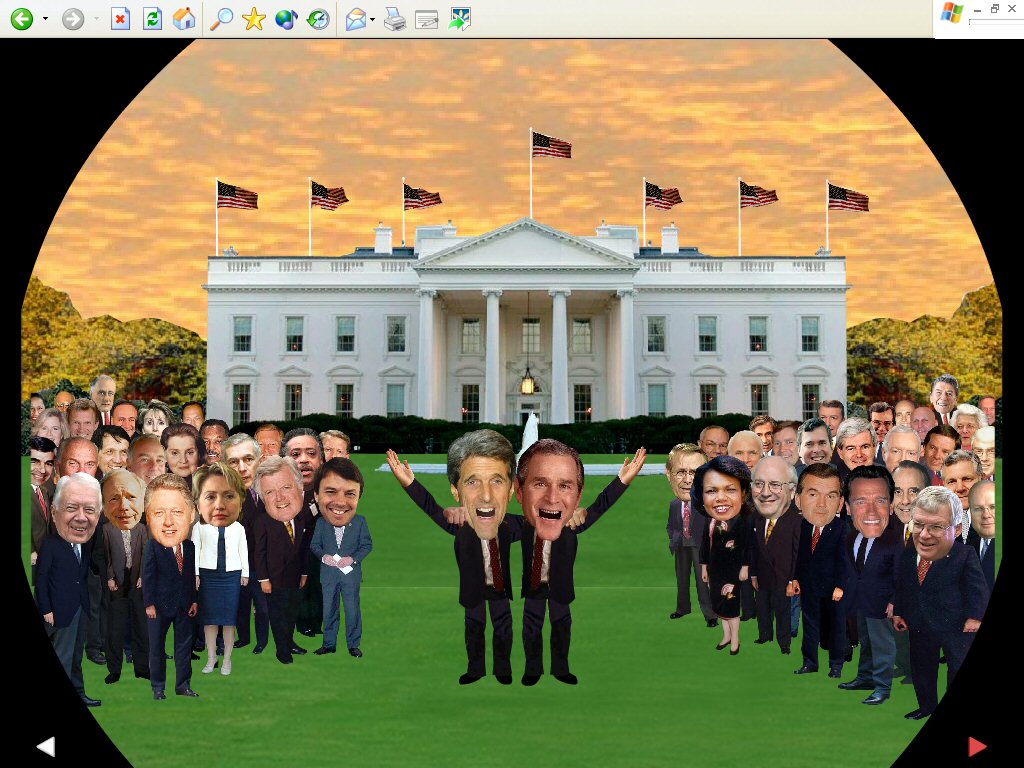
It's also fun to see who they include in the cast of supporting characters.  They flash by too fast in the animation to see everyone, so I grabbed a screen shot.  Who can you pick out on each candidate's side?  Check out Hillary's wardrobe choice and Nancy Pelosi's complexion.  Click on the image below to see the final scene full size:


See news coverage about Gregg and Evan Spiridellis, the brothers who made the animation:

http://abclocal.go.com/kgo/news/politics/071904_politics_jibjab.html  

Monday, July 19, 2004

Martha Stewart Shouldn't Have Sold Imclone: the Press Finally Takes Note

When a major newspaper breaks a major story, other newspapers quoting that story later will, as a matter of etiquette, give credit to the paper that reported the news first. Among academics, it's expected that you'll drop a footnote crediting the original source of an idea you use in your scholarly writings. Where does a blogger go to complain when a major newspaper cites a finance professor whose "working paper" rehashes news his blog broke months earlier?

On March 6, 2004 I published a piece in Wigblog entitled:

Unnoticed Irony: Imclone Stock Always Beat Martha Stewart Omnimedia

See:

http://wigblog.blogspot.com/2004_03_01_wigblog_archive.html#107859667822454858

I'd read that the FDA approved the drug Erbitux -- the same drug that they disapproved years earlier, leading to the insider trading allegations -- during Martha Stewart's trial. This got me thinking: hmm, how is Imclone stock doing? How has it done since Martha sold her shares? So I spent a couple of hours fiddling with Web stock charting services, and discovered that Imclone stock, while highly volatile, had done just fine since Martha dumped her shares.

In fact, looking carefully, it appeared that Imclone always did better than Martha's own company. So instead of selling when she got the inside tip about the FDA ruling, Martha should have bought Imclone. It turns out Imclone has always beat Martha's own company, MSO.

Now normally not that many folks read my blog, and therefore the world probably little noted nor long remembered my observation. But something funny happened: my blog was prominently profiled in The New York Times on May 27, 2004, and The Times chose to "call out" my Martha story.


After the judge sentenced Martha on Friday, the media decided to pay even more attention to her stock tale. When I picked up Saturday's Detroit Free Press, I was surprised to see a Knight-Ridder article proclaiming:

IMCLONE SHARES: Sale was a money mistake as well

http://www.freep.com/money/business/martha-imclone17e_20040717.htm

The Freep credits the article to Josh Goldstein; some Googling reveals him to be a business writer for the Philadelphia Inquirer, a sister Knight-Ridder paper.

The article quotes one Meir Statman, finance professor at Santa Clara University. [The reporter was sloppy, citing Statman of "the University of Santa Clara, Calif." That's like confusing Harvard University with the University of Harvard.] During her trial, Martha was forced to reveal details of her portfolio, and Statman analyzed her investment patterns and stock performance.

Statman writes: Last, and most ironic, Martha Stewart surely wishes, in hindsight, that she had held on to her ImClone stock. The shares she sold for less than $60 in December 2001 could have been sold for more than $85 at the end of June 2004.
http://lsb.scu.edu/finance/faculty/Statman/articles/Martha%20071204.pdf

It seems that the "unnoticed irony" that I reported in March -- and that The Times quoted in May -- got the notice of this finance prof in July. Hmm, I wonder if he reads The Times? Hmm, here's his e-mail address -- mstatman@scu.edu -- should I write him and ask? Anyhow, I like the chart I made months earlier better than his attempt, because mine depicts Imclone stock versus MSO versus the Dow Jones average all on one chart. First see my chart from March, then his from July:


Monday, July 12, 2004

Windows XP Service Pack 2 delayed -- and Information Week says it's gigabytes in size

News headlines indicate that Windows XP Service Pack 2 will be delayed. This is really important stuff for universities, because SP2 (finally!) closes some very serious holes in Windows XP. If Microsoft doesn't ship SP2 to manufacturers until August, it's too late for back-to-school computers to get these desperately-needed fixes.

Quoth Information Week:

Although the final size of Service Pack 2 is not set, the most recent beta was a beefy 264 Gbytes. Because of that size, the service pack will also be available as a free CD mailed to users who request it, Poole promised.


OK, it's only a one character goof (perhaps) but it's also a factor of 1000. Who the hell proofs these pieces? Do they understand that a CD holds only 650 megabytes, and therefore could never possibly hold 264G? Do they understand that not a single new computer ships with a 264G hard drive -- and therefore couldn't hold the purported updates?

Does the tech press even think?

Sunday, July 11, 2004

Rut-roh - Gmail is totally down

Google's Gmail service is still in beta, but I've been relying on it as my only e-mail service for a couple of months now. Google's built a huge reputation for reliability, and for good reason: on every computer I use, I keep a folder called \broken -- and in all the years I've been using Google, I've only collected one or two Google failures.


Gmail has been a different story. So far I've encountered several failures -- and right now it's been down for 30 minutes. That's right, Gmail is just plain down. At one point, instead of the Server Error boilerplate, there was an actual Error 404.


Google is reputed to have an amazing, global, self-healing file system with 100,000 servers running at data centers around the world. This outage surprises me. I guess every time I sign onto Gmail, I need to look very closely at that tiny word BETA in the logo.

Saturday, July 10, 2004

No, being on the Windows Start menu does not equate to killing Google

Someone posted to Dave Farber's mailing list a claim that Microsoft will win over Google because their search is on the Windows Start menu. Sure, that gives Bill Gates a leg up out of the starting block, but it doesn't guarantee a win at the finish line. Remember, Smarty Jones was a lock to win the Triple Crown.

Whenever I speak to a large audience I ask what their favorite search engine is. Invariably it's Google, no matter who the audience is. Google became the number one search engine after Windows 98 was released -- and Inktomi was the default when you clicked Start / Search.

Here's my retort to this foolish claim:

The claim that Windows Start placement means automatic victory is
logical, appealing, right-sounding, even seductive -- and it is
demonstrably false.

It is exactly the same claim that I heard the CEO of Inktomi make in
1998. Windows 98 would go to Inktomi when you clicked on Start /
Search. "That's it" I thought "They've won the battle." Here's what
I wrote about it at that time:

Dr. Eric Brenner, one of the founders and the Chief Technology Officer
of Inktomi, described how Inktomi serves as a back-end to a variety of
well-known commercial search services: Hot Bot, N22, Anzwers, and the
NTT goo service in Japan. Inktomi will also be the default search
service for the Microsoft home page, for MSN, and for the Start button
under Windows 98. Anzwers Australia and New Zealand Web Enguiry
Research System) represent a partnership between Inktomi and the
Australian ISP Ozemail.

http://www.infotoday.com/searcher/jun98/story4.htm

At the time, it looked like Inktomi had conquered the world. Then
Google happened. Their superior relevancy trumped whatever was on the
Start menu. The world gravitated their way. Today, do not
underestimate Google's mindshare.

Don't get me wrong. Microsoft can still win. They understand
manually-chosen Best Bets, whereas Google does not, only believing in
its robots.

But don't think the Start menu placement leads to automatic search
engine success. History has already proven that theory wrong.

/rich

Friday, July 02, 2004

Motorola first to market with dual Wi-Fi / GSM cell phone

Motorola has done it! They've come out with a cell phone that can operate over a Wi-Fi network and then seamlessly switch to a GSM cell network when you move away from the hot spot.

The FCC today approved the Motorola CN620, the first phone capable of operating on both mobile and Wi-Fi networks. Although the phone was developed by Motorola's iDEN group, the phone supports only GSM and Wi-Fi networks. Voice calls started on Wi-Fi networks can be handed off to a GSM network. The reverse is possible only for certain types of calls. Features of the phone include a large color main display, an external display, speakerphone, eight-way navigation, and PTT (push-to-talk). Although the prototype approved by the FCC operates only on GSM networks, FCC documents reveal that the final model will support all three major types of Wi-Fi (802.11b, 802.11g, and 802.11a), as well as quad-band GSM.
See: http://www.phonescoop.com/news/item.php?n=902

Speaking of Wi-Fi, today was my monthly conversation on WKAR-FM during Morning Edition. Scott Pohl and I talked about ... Wi-Fi! You can
listen to our conversation online.

Wednesday, June 30, 2004

Gmail service falters horribly

Today was not a good day in Gmail history. Transactions were slow; lots of dialog boxes popping up saying the system was unable to complete the transaction; and, worst of all, mail not delivered for many hours.

Something bad happened to the Gmail service starting about 3 days ago. I'm not sure if Google has simply handed out too many invitations and scaled the service beyond server capacity -- or if there's something more ominous about the Gmail architecture.

Even though Gmail is in beta, I've assumed that Google's awesome computer science talent and server capacity meant it's a rock-solid offering. Today, I learned that that assumption was wrong.


Delivered-To: richard.wiggins@gmail.com
Received: by 10.11.99.75 with SMTP id w75cs904cwb;
Wed, 30 Jun 2004 19:21:38 -0700 (PDT)
Received: by 10.11.100.53 with SMTP id x53mr42023cwb;
Wed, 30 Jun 2004 11:45:13 -0700 (PDT)
Return-Path:
Received: from 35.9.75.104 (HELO sys04.mail.msu.edu)
by mx.gmail.com with SMTP id v71si889436cwb;
Wed, 30 Jun 2004 11:45:13 -0700 (PDT)
Received: from cooper.user.msu.edu ([35.10.2.238])
by sys04.mail.msu.edu with asmtp (Exim 4.32 #22)
(TLSv1:RC4-SHA:128)
id 1Bfk52-00005I-SV; Wed, 30 Jun 2004 14:45:12 -0400
Mime-Version: 1.0
X-Sender: cooper (Unverified)
Message-Id:
Date: Wed, 30 Jun 2004 14:45:09 -0400
To: richard.wiggins@gmail.com, zakhem@msu.edu

Tuesday, June 29, 2004

Open letter to Google: Why no timeouts in Gmail?

I'm still pursuing the huge privacy hole in Gmail -- that it never times out. I re-submitted the query to the Help center:


Gmail never times out. If I log into a Gmail account from a public terminal (or my boss' office) and fail to log out, my session remains active forever. Someone else could read my mail forever, just by leaving the browser open.

If I log into another computer, my first session stays logged in. These are serious omissions. Competitive Webmail clients, such as Yahoo and USA.net, provide timeouts and multiple session detection. Why doesn't Gmail?

/rich

Sunday, June 27, 2004

The "Subversive Proposal" for Scholarly Publishing Celebrates 10th Anniversary

Stevan Harnad is the primary exponent of "self-archiving" in scholarly publishing. The proposal is simple: any author of a scholarly paper should be able to keep his or her own copy of it, and post it online, on his or her Web site (or the university's).

That earth-shattering proposal is now 10 years old. The Association of Research Libraries, under Ann Okerson's lead, published a small volume about the notion in the mid-90s. I stumbled across my own contribution to the discussion, including some fun legacy Gopher discussion with Paul Ginsparg. Funny -- and sad -- to realize that a decade later, you still can't reliably detect the date/time a Web page last changed:


XV. Brief Discussions -- Format, Economics, Submissions

Several messages pick up various topical threads that arose earlier in the discussion.

---------------------------------------------------------------------------

Date: Sun, 21 Aug 94 10:59:24 -0600
From: Paul Ginsparg 505-667-7353


> Date: Sat, 13 Aug 94 18:25:38 EDT
> From: "Stevan Harnad"

> The generality and adaptiveness of the www superset is impressive!
> But ftp/gopher also has a PROVIDER-side argument: In text-only,
> non-tech (non-Tex) disciplines the probability of a successful
> subversion knocking down the paper house of cards is MUCH higher
> if authors need merely store their ascii texts rather than convert
> them or learn html (trivial as it is). -- S.H.

i wasn't clear enough, and this is an important point: of course, OF
COURSE, www can be used to transmit plain text (this is a trivial
corollary of my statement that it is a superset of gopher). after all, i'm using it to transmit .tex, .dvi, .ps, etc. -- it can transmit anything, bytes are bytes. more specifically, if an http server sees a file with e.g. a .txt (or other unrecognized extension), it tells the client that plain text is on the way and the client presents it unformatted (i'm surprised you haven't encountered this before). that is why gopher is
dying out worldwide (indeed it is only naive confusion and misinformation on the above issues responsible for keeping it afloat even this long). everything gopher does, www does just as well or better (including
automatic indexing of pre-existing directories). anyway, just a matter of time -- makes little difference to worry about it on way or another.

> Once the subversion has had its effect, we can convert them to the
> virtues of hypertext, etc. (But your point on the generality of www
> is taken!).

and now the point of the hypertext project becomes clear -- we do transmit
all this non-html via www, but these have all been network dead-ends. so
rather than wait forever for some group of ncsa undergrads or whomever to
reproduce a satisfactory typesetting environment within these primitive html browsers, we've taken the shortcut of adding html capabilities to our
preferred medium and its browsers. (in particular that means i've been able to reprocess all pre-existing tex source in the new mode, and internal linkages are produced automatically, with no modification of the underlying .tex )

Paul Ginsparg

---------------------------------------------------------------------------

Date: Tue, 23 Aug 1994 08:27:14 EDT
Subject: Re: ftp vs. gopher vs. www
From: Rich Wiggins
To: Multiple recipients of list VPIEJ-L

> that is why gopher is dying out worldwide (indeed it is only naive confusion
> and misinformation on the above issues responsible for keeping it afloat
> even this long). everything gopher does, www does just as well or better
> (including automatic indexing of pre-existing directories).

This claim is not quite true. The Web does not embrace the Gopher+
extensions, which have never been popular among HTTP/HTML aficionados, and
are not implemented in Mosaic and its descendants.

Gopher+ provides a mechanism for alternate typing of documents. The theory
is that information providers might offer documents in a variety of ways and intelligent clients might help users select among them. Web folks feel
that multiple document types are handled just fine "their way" and that
alternate views can be coded as part of the HTML.

But Gopher+ also provides a mechanism for named attributes of documents --
the sort of stuff like the date of the last update, author's e-mail
address, etc. This is the sort of "meta-information" that is talked about
interminably in IETF and Web discussion groups. Gopher+ included a
mechanism for adding such attributes as of early 1993. Even in the Gopher
community, though, it seems it isn't widely exploited. There are
conventions for some meta-information in HTML, and no doubt discussions
will lead to real standards.

The "yes there is Gopher+ but it is useless" discussion has been carried
out elsewhere, and probably wouldn't be helpful here. Most new
announcements of online services seem to be coming from the Web side. In
general, I view Gopher as part of a progression from FTP to hierarchical
menus with nice titles to Web-style hypermedia. Mosaic paved the way for
the Web; now we need is bandwidth to deliver all those inline logos.

Rich Wiggins, CWIS Coordinator, Michigan State University

----------------------------------------------------------------------

Date: Tue, 23 Aug 94 13:45:43 -0600
From: Paul Ginsparg 505-667-7353

> I agree the gopher/www quibbling is trivial

as was pointed out in message you just forwarded -- that whole discussion
has been carried out through a multi-hundred message thread on
comp.infosystems.gopher and comp.infosystems.www (probably still
continues).

(although again misses that "in-line" logos are not necessary to www
servers, they are a choice -- and i was careful to make them purely
elective for everything i did, which included checking that everything
worked fine from a vt100 using lynx, so that my less well-off colleagues
are not left behind).

but it all remains irrelevant to the issue of costs of journals that we
try to focus on -- whatever the final delivery protocol (and it may in
five years be something other than what we have now, though most likely some generalization that encompasses it). but as you frequently point out,
i'm here "preaching to the converted."

Paul Ginsparg


Tuesday, June 22, 2004

Gmail server failure!

On every PC I use, I keep a folder called \broken. Whenever a Web site blows up on me -- e.g. a transaction fails due to a server glitch -- I keep a screen shot.

In all my years of intensely using Google, I think I've captured maybe only one such failure.

Today, Gmail failed me.

I was trying to pass along an invitation to a friend to join the service, and after a pause, I got back an unpleasant response:

Texas plans Wi-Fi at highway rest stops

An AP story says the Texas transportation department wants people to stop at rest areas and stay a while to rest, so they're encouraging folks by offering free Wi-Fi hot spots.


DALLAS - To encourage drivers to take more frequent breaks, the Texas Department of Transportation wants to set up free wireless Internet access at rest stops and travel information centers.

The department is accepting bids until next week and plans to choose a vendor in July. The chosen company won't be paid, however, to provide the free access.

TxDOT, which says Texas is the first state to provide such free access at rest areas, began experimenting with Wi-Fi hotspots last fall.

"The feedback we've received so far has been very positive," said Andy Keith, manager of TxDOT's maintenance division. "Texas' highways are seeing an increasing number of business travelers, truckers and RVers and access to e-mail is important to them."
....


I dunno, sometimes ideas like this can have unintended consequences.

-- What if those truckers stay up all night in chat rooms instead of resting?

-- What if um, professional services folks use the Internet to meet clients?

-- What if those without an ISP set up camp and never leave?

Thursday, June 03, 2004

Richard Hale Shaw, Steaks, Scotch, and Ann Arbor Insights as to State of Computing in Five Years

Tonight I am privileged to visit the home of Richard Hale Shaw, a well-known tech author (he spent years on the masthead of PC Magazine) and internationally renowned expert on Microsoft in general and .Net in particular.
Richard and wife live in a wonderful charming townhouse that's kitty-cornered across from a holy spot in Ann Arbor, Michigan -- Zingerman's deli. Alas, they are moving to Cambridge, Mass as his wife takes up a faculty post at Harvard. It is Michigan's loss, and Boston's gain.

Richard has invited a group of distinguished A**2 tech pals to smoke cigars, eat steak, sip Scotch, and talk about computing and the future. Richard's ground rules demand no locker room talk, but the visitor from East Lansing at times tests the limits while insisting to the Ann Arborites that a provost is the chief academic officer of a university, a sole critter, not one of many.

Anyone could learn a ton from these people. They're doing serious projects and are seriously connected. Tech TV never had anything on their insights. I've brought my Picturebook handheld and my Verizon 1xRTT connection so we can blog in real time. I'm asking those assembled to take my computer and type some thoughts about where computing and the Internet will take us in five years. Their smoke-filled answers:


Where will technology be in a significant way within five yaars?

Increasingly software development tools will enable domain experts to "code" complex and powerful solutions as end-user solutions. Traditional programmers will be still be necessary for infrastructure support, but the coding of the business logic
will move directly into the hands of the experts themselves.


Greg Poirier (Thomson - Creative Solutions)


The idea of a software application as something that you install on a machine and then run will give way to applications as collections of loosely-coupled services working together to address specific use cases. Each individual service may participate in any number of overlapping groups of services and users will be unaware of which indidual services are involve and where those services are actually located. Very rarely will anyone every run an "installer".

F. Andy Seidl, MyST Technology Partners


Richard Hale Shaw is a giant in the software industry. Without his time and dedication I can't imagine the state of the software industry today. Seriously though, Richard has been a tremendous influence on me and on the software industry here in Ann Arbor. We're going to miss him more than we realize!

Bill Heitzeg


In five years, more humans will be even more confused than they are presently; pen and paper will be the source of romance.

Randy Rivet, Onlooker

The state of computing five years from now: small, personalized, and very portable. Hopefully creative solutions will emerge to give more meaningful visual representations of the structure of information.

Alan G. Jackson


The state of computing 5 years from now: spam will have been eliminated, but the cost of sending email will be borne by the user (albeit in tiny incremental costs per email sent). In addition, new devices will have been invented to sift through and find blogs, because blogging will become so ubiquitous that it will start to overtake the rest of web content. Google will have acquired Yahoo, and will either partner with Microsoft or will be in a major rivalry war over search engine revenues. IBM will finally dispose of its old Sun Microsystems division. Internet bandwidth in the US will still largely be higher than elsewhere, but wireless in the US will be running at the range of current-day wired bandwidth. Fold-out laptop screens will let you display up to 3x as much desktop space as you can see today.

All blogging tools will have word-wrap unlike this one.

Richard Hale Shaw


You can see all of my photos from this meaty event in my Imagestation album.