
Thursday, September 02, 2004
Weather Channel loses track of Hurricane Frances
Worried about whether Hurricane Frances is stalking some favorite haunts in Florida, I went to Weather.com. Alas, the site offers up a graphic that claims there are no storms to track. It's in the wee hours at the Weather.com headquarters, and someone has pushed the wrong button.


Monday, August 16, 2004
Windows XP SP2 Critical Update defers to fixing "unacceptable" font
It's the first anniversary of the devastating Blaster worm, which wrought havoc around the world, especially at universities. In its wisdom, Microsoft has timed the release of Windows XP Service Pack 2 for the anniversary, which means that this year millions of students will return to school, plug into the campus network, and discover that Windows Update wants to install SP 2. It's a "critical update" delivered at the worst possible time for college campuses. (Microsoft also won't let universities build patch CDs with SP2 for students in residence halls, citing its copyright policy.) 
Word on the street is that Microsoft is dribbling out the SP2 release. Only a few folks will be offered this "critical update" at first. It's not clear what the random sampling process is. Curious if my new Thinkpad running XP Pro would catch SP2, I ran Windows Update.
To my utter astonishment, I do need a "critical update" -- for a font!
Critical Update for Windows (KB833407) Download size: 309 KB, less than 1 minute
This item updates the Bookshelf Symbol 7 font included in some Microsoft products. The font has been found to contain unacceptable symbols. After you install this item, you may have to restart your computer.
A little bit of Googling reveals that one of the characters in Bookshelf 7 resembles a swastika. I don't know if it is a swastika or not, as other cultures have produced symbols that resemble that offensive sign used by the Nazis centuries later.

It seems the Anti-Defamation League raised this issue with Microsoft in 2003, and Microsoft agreed to replace the font table with a new one sans pseudo-swastika. While that's probably the best move for Microsoft to make, there is no excuse for putting out as CRITICAL a new font table just because a symbol in it is objectionable. A critical update should be something critical to the operation of my computer. I have never even gone near the Bookshelf 7 fonts myself, and I've never encountered a Web page that exploited the offending character. Meanwhile, the really critical update, SP2, isn't available, and will start to appear, randomly, starting today. So you can't get XP SP2 as an end user if you want it, other than if randomly chosen, and you will get the Bookshelf Critical Update whether you want it or not.
Word on the street is that Microsoft is dribbling out the SP2 release. Only a few folks will be offered this "critical update" at first. It's not clear what the random sampling process is. Curious if my new Thinkpad running XP Pro would catch SP2, I ran Windows Update.
To my utter astonishment, I do need a "critical update" -- for a font!
Critical Update for Windows (KB833407) Download size: 309 KB, less than 1 minute
This item updates the Bookshelf Symbol 7 font included in some Microsoft products. The font has been found to contain unacceptable symbols. After you install this item, you may have to restart your computer.
A little bit of Googling reveals that one of the characters in Bookshelf 7 resembles a swastika. I don't know if it is a swastika or not, as other cultures have produced symbols that resemble that offensive sign used by the Nazis centuries later.
It seems the Anti-Defamation League raised this issue with Microsoft in 2003, and Microsoft agreed to replace the font table with a new one sans pseudo-swastika. While that's probably the best move for Microsoft to make, there is no excuse for putting out as CRITICAL a new font table just because a symbol in it is objectionable. A critical update should be something critical to the operation of my computer. I have never even gone near the Bookshelf 7 fonts myself, and I've never encountered a Web page that exploited the offending character. Meanwhile, the really critical update, SP2, isn't available, and will start to appear, randomly, starting today. So you can't get XP SP2 as an end user if you want it, other than if randomly chosen, and you will get the Bookshelf Critical Update whether you want it or not.
Thursday, August 12, 2004
Create your own postage stamps featuring your own photos
Stamps.com has come up with a very clever new idea. They'll make postage stamps for you featuring whatever image you want. Imagine:
-- The photo on the stamp you put on your wedding invitation isn't wedding cake models -- it's you, the happy couple.
-- Your holiday letter depicts your perfect family, whose perfect year is described in infinite detail in the annual letter within.
-- You send out various mailings whose envelopes feature stamps showing off your lovely dog, cat, baby, vacation photos, the cottage up north your friends covet, etc.
The Photo stamp is really just the electronically coded postage stamp that Stamps.com provides under license from the USPS, with an ancillary photo, um, glued alongside it. The cost is steep: 85 cents per stamp for a sheet of twenty 37 cent stamps, not including $2.99 shipping. I bet it'll be a huge hit nonetheless. Wedding photographers will sell you postage stamps for your thank-you notes that feature you and your smiling spouse. Not a bad way for a dot com to reinvent itself.
If the folks at Stamps.com were really clever, they'd create a marketplace and let you choose popular photos and graphics from an image bank. Sure, you could upload your own photos, but you could also choose from the photos offered by professional photographers and freelancers. Stamps.com could let people and organizations sell images for stamps and collect royalties: a marketplace for personalized stamps. Institutions -- recording artists, politicians, cities, universities, car companies, resorts -- anyone could sell image-branded stamps.
http://photo.stamps.com
The original business model for Stamps.com was simple: print your own postage stamps on your own laser printer -- Pitney-Bowes for the masses, postage stamps you print as you need them -- a very clever concept for the late 90s. But was a clever idea that never caught on. I'm betting that personalized postage stamps will take off in a big way. You'll order the stamps over the Web, you'll pay twice what they're worth, and you won't print them in your basement; you'll receive them ... in the mail. Ahh, irony,
Oh, to be perfectly accurate, I shouldn't say you can have ANY image on your stamp; there's a long list of terms and conditions.
-- The photo on the stamp you put on your wedding invitation isn't wedding cake models -- it's you, the happy couple.
-- Your holiday letter depicts your perfect family, whose perfect year is described in infinite detail in the annual letter within.
-- You send out various mailings whose envelopes feature stamps showing off your lovely dog, cat, baby, vacation photos, the cottage up north your friends covet, etc.
The Photo stamp is really just the electronically coded postage stamp that Stamps.com provides under license from the USPS, with an ancillary photo, um, glued alongside it. The cost is steep: 85 cents per stamp for a sheet of twenty 37 cent stamps, not including $2.99 shipping. I bet it'll be a huge hit nonetheless. Wedding photographers will sell you postage stamps for your thank-you notes that feature you and your smiling spouse. Not a bad way for a dot com to reinvent itself.
If the folks at Stamps.com were really clever, they'd create a marketplace and let you choose popular photos and graphics from an image bank. Sure, you could upload your own photos, but you could also choose from the photos offered by professional photographers and freelancers. Stamps.com could let people and organizations sell images for stamps and collect royalties: a marketplace for personalized stamps. Institutions -- recording artists, politicians, cities, universities, car companies, resorts -- anyone could sell image-branded stamps.
http://photo.stamps.com
The original business model for Stamps.com was simple: print your own postage stamps on your own laser printer -- Pitney-Bowes for the masses, postage stamps you print as you need them -- a very clever concept for the late 90s. But was a clever idea that never caught on. I'm betting that personalized postage stamps will take off in a big way. You'll order the stamps over the Web, you'll pay twice what they're worth, and you won't print them in your basement; you'll receive them ... in the mail. Ahh, irony,
Oh, to be perfectly accurate, I shouldn't say you can have ANY image on your stamp; there's a long list of terms and conditions.
Tuesday, August 10, 2004
Flood takes Auburn University off the Web
Today I was scanning the Net trying to find out how universities name their Wi-Fi hotspots (or their wireless networks in general). I was surprised to discover that a flood had taken Auburn University off the Internet:

Thursday, July 29, 2004
Blogging Across the United States: Cyber Quest 2004
The quest begins. My friend Dean Shooltz, brilliant scientist and inveterate collector of equipment and vehicles, is in pursuit of a scientific instrument that once was worth many thousands of dollars, and now is for sale for a few hundred dollars.

Someone in San Diego is selling this thingamabob, which means Dean has to get from East Lansing to the southernmost city in California and back. Yes, he could have the whatchamahoozit shipped, but Dean figures that'd be expensive, and if he goes in person, he can disassemble the gizmo and fit it in a car.
So Dean enlisted the help of friends Mike and Colleen. They're going to drive non-stop across the country, pick up and pack the gadget, maybe do some extra sight-seeing, and then drive back non-stop.
Since they've got three drivers, I challenged them to blog the whole trip in real time. I offered my Sony VAIO Picturebook laptop with my Verizon Wireless / Sierra Wireless 1xRTT card, and an AC inverter that plugs into a cigarette lighter outlet. This will give Mike, Dean, and Colleen mobile Internet access just about everywhere they go. The Verizon service map shows lots more gaps out West, but the major roads and cities are covered. So they should be able to blog at will pretty much wherever they are.
The Picturebook has a built-in camera so they can shoot low-res shots as they travel. Dean has a Sony digital still camera, so they can take a MemoryStick and insert it in the VAIO to upload photos.
We met tonight at the Peanut Barrel, an East Lansing institution, where I showed them the ins and outs of the Picturebook. Colleen took the little laptop and had a new Blogger blog up in minutes.
Parting with the little Picturebook was not easy. I'm now using an IBM Thinkpad X40, which is much more powerful than the little laptop, and I'm now using Wi-Fi (in lieu of the Verizon service) at my day job, at home, and elsewhere for most of my Internet access. I made it very clear to Dean et al that I do want the Picturebook back at the end of the trip.


Read all about it, and watch the photos, at http://cyberquest2004.blogspot.com/
Someone in San Diego is selling this thingamabob, which means Dean has to get from East Lansing to the southernmost city in California and back. Yes, he could have the whatchamahoozit shipped, but Dean figures that'd be expensive, and if he goes in person, he can disassemble the gizmo and fit it in a car.
So Dean enlisted the help of friends Mike and Colleen.
They're going to drive non-stop across the country, pick up and pack the gadget, maybe do some extra sight-seeing, and then drive back non-stop.
Since they've got three drivers, I challenged them to blog the whole trip in real time. I offered my Sony VAIO Picturebook laptop with my Verizon Wireless / Sierra Wireless 1xRTT card, and an AC inverter that plugs into a cigarette lighter outlet. This will give Mike, Dean, and Colleen mobile Internet access just about everywhere they go. The Verizon service map shows lots more gaps out West, but the major roads and cities are covered. So they should be able to blog at will pretty much wherever they are.
The Picturebook has a built-in camera so they can shoot low-res shots as they travel. Dean has a Sony digital still camera, so they can take a MemoryStick and insert it in the VAIO to upload photos.
We met tonight at the Peanut Barrel, an East Lansing institution, where I showed them the ins and outs of the Picturebook. Colleen took the little laptop and had a new Blogger blog up in minutes.
Parting with the little Picturebook was not easy. I'm now using an IBM Thinkpad X40, which is much more powerful than the little laptop, and I'm now using Wi-Fi (in lieu of the Verizon service) at my day job, at home, and elsewhere for most of my Internet access. I made it very clear to Dean et al that I do want the Picturebook back at the end of the trip.
Read all about it, and watch the photos, at http://cyberquest2004.blogspot.com/
Wednesday, July 28, 2004
National Post Breaks Embargo of Edwards Speech
So I'm sitting here checking Google News while getting ready to watch coverage of the Democratic National Convention on PBS (and C-Span, when the PBS punditry pisses me off). 
And right there is coverage of what John Edwards said in his speech to the convention. The National Post, a conservative newspaper in Canada, is reporting on its Web site what Edwards said to the delegates.
There's only one problem: John Edwards has not given that speech yet.
This is a game called "embargoed news": the text of the speech has already been given to the media, so that those with early deadlines can report the news for tomorrow's papers (or other media) even though the words haven't been uttered. The reporters get the words before the actual speech, on the condition that they don't report the contents until the actual speech is over.
I'm writing this just after 8:00 PM Eastern time. The National Post has leapt into the future by a couple of hours. It will be interesting to see if the actual speech matches what they've quoted from the advance copy.

And right there is coverage of what John Edwards said in his speech to the convention. The National Post, a conservative newspaper in Canada, is reporting on its Web site what Edwards said to the delegates.
There's only one problem: John Edwards has not given that speech yet.
This is a game called "embargoed news": the text of the speech has already been given to the media, so that those with early deadlines can report the news for tomorrow's papers (or other media) even though the words haven't been uttered. The reporters get the words before the actual speech, on the condition that they don't report the contents until the actual speech is over.
I'm writing this just after 8:00 PM Eastern time. The National Post has leapt into the future by a couple of hours. It will be interesting to see if the actual speech matches what they've quoted from the advance copy.
Thursday, July 22, 2004
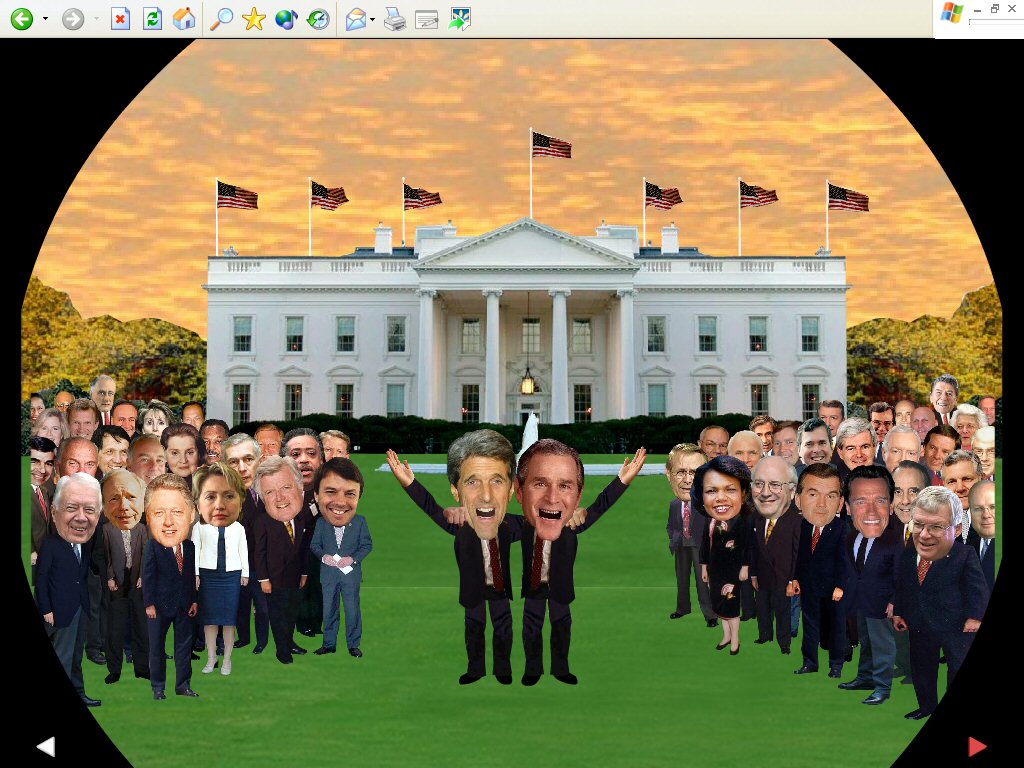
Worth a look: hilarious animation spoofs Bush vs. Kerry
Check out this cute animation spoofing the trivial discourse in Presidential elections, sung to the tune of "This Land Is Your Land." Skewers both sides equally. Highly recommended. Turn up your audio. Watch it again and look at the backgrounds. This is the official link:
http://www.jibjab.com/
This link also works, slightly different packaging allows resizing for full screen viewing:
http://www.clarkson.edu/~hollenca/this_land_mov.swf


It's also fun to see who they include in the cast of supporting characters. They flash by too fast in the animation to see everyone, so I grabbed a screen shot. Who can you pick out on each candidate's side? Check out Hillary's wardrobe choice and Nancy Pelosi's complexion. Click on the image below to see the final scene full size:

See news coverage about Gregg and Evan Spiridellis, the brothers who made the animation:
http://abclocal.go.com/kgo/news/politics/071904_politics_jibjab.html
http://www.jibjab.com/
This link also works, slightly different packaging allows resizing for full screen viewing:
http://www.clarkson.edu/~hollenca/this_land_mov.swf
It's also fun to see who they include in the cast of supporting characters. They flash by too fast in the animation to see everyone, so I grabbed a screen shot. Who can you pick out on each candidate's side? Check out Hillary's wardrobe choice and Nancy Pelosi's complexion. Click on the image below to see the final scene full size:
See news coverage about Gregg and Evan Spiridellis, the brothers who made the animation:
http://abclocal.go.com/kgo/news/politics/071904_politics_jibjab.html
Monday, July 19, 2004
Martha Stewart Shouldn't Have Sold Imclone: the Press Finally Takes Note
When a major newspaper breaks a major story, other newspapers quoting that story  later will, as a matter of etiquette, give credit to the paper that reported the news first. Among academics, it's expected that you'll drop a footnote crediting the original source of an idea you use in your scholarly writings. Where does a blogger go to complain when a major newspaper cites a finance professor whose "working paper" rehashes news his blog broke months earlier?
On March 6, 2004 I published a piece in Wigblog entitled:
Unnoticed Irony: Imclone Stock Always Beat Martha Stewart Omnimedia
See:
http://wigblog.blogspot.com/2004_03_01_wigblog_archive.html#107859667822454858
I'd read that the FDA approved the drug Erbitux -- the same drug that they disapproved years earlier, leading to the insider trading allegations -- during Martha Stewart's trial. This got me thinking: hmm, how is Imclone stock doing? How has it done since Martha sold her shares? So I spent a couple of hours fiddling with Web stock charting services, and discovered that Imclone stock, while highly volatile, had done just fine since Martha dumped her shares.
In fact, looking carefully, it appeared that Imclone always did better than Martha's own company. So instead of selling when she got the inside tip about the FDA ruling, Martha should have bought Imclone. It turns out Imclone has always beat Martha's own company, MSO.
Now normally not that many folks read my blog, and therefore the world probably little noted nor long remembered my observation. But something funny happened: my blog was prominently profiled in The New York Times on May 27, 2004, and The Times chose to "call out" my Martha story.

After the judge sentenced Martha on Friday, the media decided to pay even more attention to her stock tale. When I picked up Saturday's Detroit Free Press, I was surprised to see a Knight-Ridder article proclaiming:
IMCLONE SHARES: Sale was a money mistake as well
http://www.freep.com/money/business/martha-imclone17e_20040717.htm
The Freep credits the article to Josh Goldstein; some Googling reveals him to be a business writer for the Philadelphia Inquirer, a sister Knight-Ridder paper.

The article quotes one Meir Statman, finance professor at Santa Clara University. [The reporter was sloppy, citing Statman of "the University of Santa Clara, Calif." That's like confusing Harvard University with the University of Harvard.] During her trial, Martha was forced to reveal details of her portfolio, and Statman analyzed her investment patterns and stock performance.
Statman writes: Last, and most ironic, Martha Stewart surely wishes, in hindsight, that she had held on to her ImClone stock. The shares she sold for less than $60 in December 2001 could have been sold for more than $85 at the end of June 2004.
http://lsb.scu.edu/finance/faculty/Statman/articles/Martha%20071204.pdf
It seems that the "unnoticed irony" that I reported in March -- and that The Times quoted in May -- got the notice of this finance prof in July. Hmm, I wonder if he reads The Times? Hmm, here's his e-mail address -- mstatman@scu.edu -- should I write him and ask? Anyhow, I like the chart I made months earlier better than his attempt, because mine depicts Imclone stock versus MSO versus the Dow Jones average all on one chart. First see my chart from March, then his from July:


later will, as a matter of etiquette, give credit to the paper that reported the news first. Among academics, it's expected that you'll drop a footnote crediting the original source of an idea you use in your scholarly writings. Where does a blogger go to complain when a major newspaper cites a finance professor whose "working paper" rehashes news his blog broke months earlier?
On March 6, 2004 I published a piece in Wigblog entitled:
Unnoticed Irony: Imclone Stock Always Beat Martha Stewart Omnimedia
See:
http://wigblog.blogspot.com/2004_03_01_wigblog_archive.html#107859667822454858
I'd read that the FDA approved the drug Erbitux -- the same drug that they disapproved years earlier, leading to the insider trading allegations -- during Martha Stewart's trial. This got me thinking: hmm, how is Imclone stock doing? How has it done since Martha sold her shares? So I spent a couple of hours fiddling with Web stock charting services, and discovered that Imclone stock, while highly volatile, had done just fine since Martha dumped her shares.
In fact, looking carefully, it appeared that Imclone always did better than Martha's own company. So instead of selling when she got the inside tip about the FDA ruling, Martha should have bought Imclone. It turns out Imclone has always beat Martha's own company, MSO.
Now normally not that many folks read my blog, and therefore the world probably little noted nor long remembered my observation. But something funny happened: my blog was prominently profiled in The New York Times on May 27, 2004, and The Times chose to "call out" my Martha story.
After the judge sentenced Martha on Friday, the media decided to pay even more attention to her stock tale. When I picked up Saturday's Detroit Free Press, I was surprised to see a Knight-Ridder article proclaiming:
IMCLONE SHARES: Sale was a money mistake as well
http://www.freep.com/money/business/martha-imclone17e_20040717.htm
The Freep credits the article to Josh Goldstein; some Googling reveals him to be a business writer for the Philadelphia Inquirer, a sister Knight-Ridder paper.
The article quotes one Meir Statman, finance professor at Santa Clara University. [The reporter was sloppy, citing Statman of "the University of Santa Clara, Calif." That's like confusing Harvard University with the University of Harvard.] During her trial, Martha was forced to reveal details of her portfolio, and Statman analyzed her investment patterns and stock performance.
Statman writes: Last, and most ironic, Martha Stewart surely wishes, in hindsight, that she had held on to her ImClone stock. The shares she sold for less than $60 in December 2001 could have been sold for more than $85 at the end of June 2004.
http://lsb.scu.edu/finance/faculty/Statman/articles/Martha%20071204.pdf
It seems that the "unnoticed irony" that I reported in March -- and that The Times quoted in May -- got the notice of this finance prof in July. Hmm, I wonder if he reads The Times? Hmm, here's his e-mail address -- mstatman@scu.edu -- should I write him and ask? Anyhow, I like the chart I made months earlier better than his attempt, because mine depicts Imclone stock versus MSO versus the Dow Jones average all on one chart. First see my chart from March, then his from July:
Monday, July 12, 2004
Windows XP Service Pack 2 delayed -- and Information Week says it's gigabytes in size
News headlines indicate that Windows XP Service Pack 2 will be delayed. This is really important stuff for universities,  because SP2 (finally!) closes some very serious holes in Windows XP. If Microsoft doesn't ship SP2 to manufacturers until August, it's too late for back-to-school computers to get these desperately-needed fixes.
Quoth Information Week:
Although the final size of Service Pack 2 is not set, the most recent beta was a beefy 264 Gbytes. Because of that size, the service pack will also be available as a free CD mailed to users who request it, Poole promised.
OK, it's only a one character goof (perhaps) but it's also a factor of 1000. Who the hell proofs these pieces? Do they understand that a CD holds only 650 megabytes, and therefore could never possibly hold 264G? Do they understand that not a single new computer ships with a 264G hard drive -- and therefore couldn't hold the purported updates?
Does the tech press even think?
because SP2 (finally!) closes some very serious holes in Windows XP. If Microsoft doesn't ship SP2 to manufacturers until August, it's too late for back-to-school computers to get these desperately-needed fixes.
Quoth Information Week:
Although the final size of Service Pack 2 is not set, the most recent beta was a beefy 264 Gbytes. Because of that size, the service pack will also be available as a free CD mailed to users who request it, Poole promised.
OK, it's only a one character goof (perhaps) but it's also a factor of 1000. Who the hell proofs these pieces? Do they understand that a CD holds only 650 megabytes, and therefore could never possibly hold 264G? Do they understand that not a single new computer ships with a 264G hard drive -- and therefore couldn't hold the purported updates?
Does the tech press even think?
Sunday, July 11, 2004
Rut-roh - Gmail is totally down
Google's Gmail service is still in beta, but I've been relying on it as my only e-mail service for a couple of months now. Google's built a huge reputation for reliability, and for good reason: on every computer I use, I keep a folder called \broken -- and in all the years I've been using Google, I've only collected one or two Google failures.

Gmail has been a different story. So far I've encountered several failures -- and right now it's been down for 30 minutes. That's right, Gmail is just plain down. At one point, instead of the Server Error boilerplate, there was an actual Error 404.

Google is reputed to have an amazing, global, self-healing file system with 100,000 servers running at data centers around the world. This outage surprises me. I guess every time I sign onto Gmail, I need to look very closely at that tiny word BETA in the logo.
Gmail has been a different story. So far I've encountered several failures -- and right now it's been down for 30 minutes. That's right, Gmail is just plain down. At one point, instead of the Server Error boilerplate, there was an actual Error 404.
Google is reputed to have an amazing, global, self-healing file system with 100,000 servers running at data centers around the world. This outage surprises me. I guess every time I sign onto Gmail, I need to look very closely at that tiny word BETA in the logo.
Saturday, July 10, 2004
No, being on the Windows Start menu does not equate to killing Google
Someone posted to Dave Farber's mailing list a claim that Microsoft will win over Google because their search is on the Windows Start menu. Sure, that gives Bill Gates a leg up out of the starting block, but it doesn't guarantee a win at the finish line. Remember, Smarty Jones was a lock to win the Triple Crown.
Whenever I speak to a large audience I ask what their favorite search engine is. Invariably it's Google, no matter who the audience is. Google became the number one search engine after Windows 98 was released -- and Inktomi was the default when you clicked Start / Search.
Here's my retort to this foolish claim:
The claim that Windows Start placement means automatic victory is
logical, appealing, right-sounding, even seductive -- and it is
demonstrably false.
It is exactly the same claim that I heard the CEO of Inktomi make in
1998. Windows 98 would go to Inktomi when you clicked on Start /
Search. "That's it" I thought "They've won the battle." Here's what
I wrote about it at that time:
Dr. Eric Brenner, one of the founders and the Chief Technology Officer
of Inktomi, described how Inktomi serves as a back-end to a variety of
well-known commercial search services: Hot Bot, N22, Anzwers, and the
NTT goo service in Japan. Inktomi will also be the default search
service for the Microsoft home page, for MSN, and for the Start button
under Windows 98. Anzwers Australia and New Zealand Web Enguiry
Research System) represent a partnership between Inktomi and the
Australian ISP Ozemail.
http://www.infotoday.com/searcher/jun98/story4.htm
At the time, it looked like Inktomi had conquered the world. Then
Google happened. Their superior relevancy trumped whatever was on the
Start menu. The world gravitated their way. Today, do not
underestimate Google's mindshare.
Don't get me wrong. Microsoft can still win. They understand
manually-chosen Best Bets, whereas Google does not, only believing in
its robots.
But don't think the Start menu placement leads to automatic search
engine success. History has already proven that theory wrong.
/rich
Whenever I speak to a large audience I ask what their favorite search engine is. Invariably it's Google, no matter who the audience is. Google became the number one search engine after Windows 98 was released -- and Inktomi was the default when you clicked Start / Search.
Here's my retort to this foolish claim:
The claim that Windows Start placement means automatic victory is
logical, appealing, right-sounding, even seductive -- and it is
demonstrably false.
It is exactly the same claim that I heard the CEO of Inktomi make in
1998. Windows 98 would go to Inktomi when you clicked on Start /
Search. "That's it" I thought "They've won the battle." Here's what
I wrote about it at that time:
Dr. Eric Brenner, one of the founders and the Chief Technology Officer
of Inktomi, described how Inktomi serves as a back-end to a variety of
well-known commercial search services: Hot Bot, N22, Anzwers, and the
NTT goo service in Japan. Inktomi will also be the default search
service for the Microsoft home page, for MSN, and for the Start button
under Windows 98. Anzwers Australia and New Zealand Web Enguiry
Research System) represent a partnership between Inktomi and the
Australian ISP Ozemail.
http://www.infotoday.com/searcher/jun98/story4.htm
At the time, it looked like Inktomi had conquered the world. Then
Google happened. Their superior relevancy trumped whatever was on the
Start menu. The world gravitated their way. Today, do not
underestimate Google's mindshare.
Don't get me wrong. Microsoft can still win. They understand
manually-chosen Best Bets, whereas Google does not, only believing in
its robots.
But don't think the Start menu placement leads to automatic search
engine success. History has already proven that theory wrong.
/rich
Friday, July 02, 2004
Motorola first to market with dual Wi-Fi / GSM cell phone
Motorola has done it! They've come out with a cell phone that can operate over a Wi-Fi network and then seamlessly switch to a GSM cell network when you move away from the hot spot.
The FCC today approved the Motorola CN620, the first phone capable of operating on both mobile and Wi-Fi networks. Although the phone was developed by Motorola's iDEN group, the phone supports only GSM and Wi-Fi networks. Voice calls started on Wi-Fi networks can be handed off to a GSM network. The reverse is possible only for certain types of calls. Features of the phone include a large color main display, an external display, speakerphone, eight-way navigation, and PTT (push-to-talk). Although the prototype approved by the FCC operates only on GSM networks, FCC documents reveal that the final model will support all three major types of Wi-Fi (802.11b, 802.11g, and 802.11a), as well as quad-band GSM. See: http://www.phonescoop.com/news/item.php?n=902
Speaking of Wi-Fi, today was my monthly conversation on WKAR-FM during Morning Edition. Scott Pohl and I talked about ... Wi-Fi! You can
listen to our conversation online.
The FCC today approved the Motorola CN620, the first phone capable of operating on both mobile and Wi-Fi networks. Although the phone was developed by Motorola's iDEN group, the phone supports only GSM and Wi-Fi networks. Voice calls started on Wi-Fi networks can be handed off to a GSM network.
The reverse is possible only for certain types of calls. Features of the phone include a large color main display, an external display, speakerphone, eight-way navigation, and PTT (push-to-talk). Although the prototype approved by the FCC operates only on GSM networks, FCC documents reveal that the final model will support all three major types of Wi-Fi (802.11b, 802.11g, and 802.11a), as well as quad-band GSM. See: http://www.phonescoop.com/news/item.php?n=902
Speaking of Wi-Fi, today was my monthly conversation on WKAR-FM during Morning Edition. Scott Pohl and I talked about ... Wi-Fi! You can
listen to our conversation online.
Subscribe to:
Posts (Atom)