See:
Wednesday, July 26, 2006
Fascinating article on how users interact with Web sites
See:
Saturday, July 22, 2006
Daddy! Daddy! They've got WeeFee!!!
One young lad, age 6 or so, was already excited but his eyes really lit up when he saw a banner above the entrance.
"Daddy! Daddy! They've got WeeFee!!!" he proclaimed.
And sure enough they did. I just didn't know the correct pronunciation.
American Express renames me: &$$htmBegin&$$
Click to see full-size image
We've all seen this sort of thing before, where a distributed database or mass mailing system makes a goofy substitution or fails to substitute the customer name for the generic field name. There's a funny folk song about material addressed to "Your State Name Here."
Over the years I've heard some hilarious examples:
- My friend Mark Grebner, whose firm is the leading political mailing list service in Michigan, puzzled over why so many people have a surname of Usafret. What the heck ethnicity is that? He figured out that it's USAF (Ret.) -- a retired member of the Air Force.
- My wife's friend Deb Biggs once got mail addressed to Ded Buggs.
- And the all time winner of the trifecta, Mark Allen Knopper, at the time a network engineer for the Merit network, received mail addressed to Mirv Alien Knipper. Yup, all three of his names transformed. For years thereafter people called him Mirv.
I'd love to legally change my name to &$$htmBegin&$$ but like Spock I'm afraid you wouldn't know how to pronounce it.
Sunday, July 16, 2006
Our book on search analytics - competing with itself thanks to O'Reilly
We're really excited about the book. We're learning great things by interviewing some very smart people who work for leading search technology companies, or leading companies exploiting search analytics. Thanks to Lou's reputation and his extensive network of friends in the information architecture field, we're able to connect with wise folks who can teach us a lot.
Please check out the Web site for the book where we're discussing our learning process as we go:
http://www.rosenfeldmedia.com/books/searchanalytics
Now that's all great news... Here's a frustrating footnote. Last year Lou and I submitted a proposal to the noted computer publisher O'Reilly. We were still in discussions with them when they mailed me a contract! It took a little longer for Lou to receive his copy, but we hadn't agreed to write the book for them, and by then Lou had decided to proceed with his own imprint. We confirmed to O'Reilly that we wouldn't sign the contract and would publish elsewhere.
Imagine my surprise one day in April 2006 when, while merrily Googling away doing research for the book, I discovered you could already buy it! O'Reilly had assigned the book an ISBN -- 0596101910 -- and submitted it to the Amazons of the world as a soon-to-be-published book!
Poking around a bit I found that Amazon.uk, Powell's, and several other outlets listed the book. Some sites even accepter pre-orders! At first this was mildly amusing.
On May 1, Lou politely asked a contact at O'Reilly (aka ORA) to excise the book from the publishing world's pipeline. We eventually received word that they would.
Now it's July 16, and the book now appears on more publishing outlets than it did on May 1. You can buy "our book" in Canada, the UK, Germany, and Japan. Powell's, the legendary bookseller in Portland, Oregon, has it.
This is more than a little bit frustrating, and no longer a bit amusing. As our real book moves closer to publication, the phantom title could cause serious confusion in the marketplace. ORA tells us that once they ship an ISBN out on a book industry network called Onix, it's hard to retract it from booksellers.
Regardless of whatever technical hurdles ORA faces in undoing this mess, it seems to me they are obliged to un-do what they've done -- promptly.
Click below to see the Japanese, UK, and German -- and US -- versions of the problem.
Wednesday, July 05, 2006
Tuesday, June 27, 2006
Yipes, Yahoo is down
For instance:
var _phppl="";function plinks(){ this.openPlink
Sunday, June 18, 2006
Charging an arm and a leg
I said "$15 a leg."
A puzzled look crossed her face. "They charge by the leg?!"
It took me a second to disentangle our crossed communications. I explained it's $15 per leg of the journey, not per leg of the passenger.
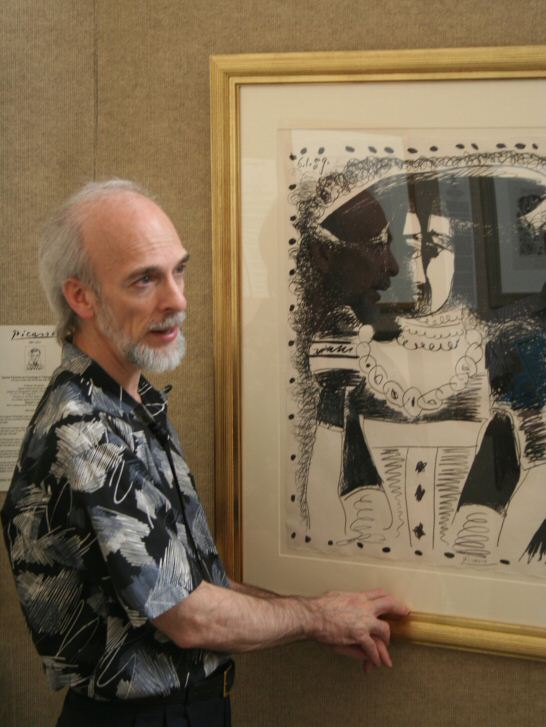
Saper reflects on Picasso and Cubism
I noticed that Roy's reflection in the glass echoed the point he was making:
The lithograph is entitled "Noble Dame" and Picasso made it in 1959.
Roy says the exhibit runs through July 2, but his gallery and two partner galleries will offer items not yet sold from this collection for some time to come.
Tuesday, June 13, 2006
Thursday, June 08, 2006
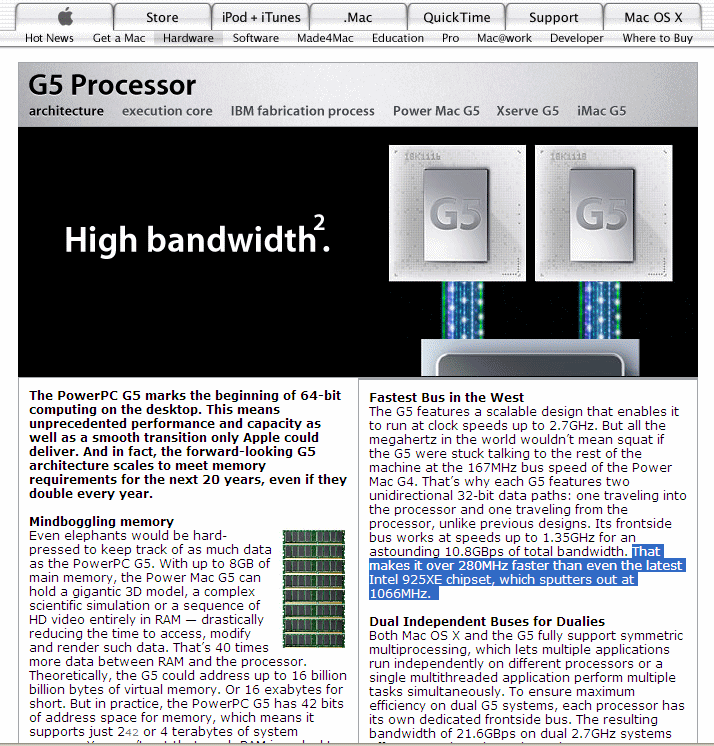
Apple Web site STILL touts advantages of PowerPC chip over Intel
Of course, now Apple has famously switched to Intel processors, and they offer nothing but praise of Intel CPUs. Gee, isn't it odd how they used to deride the Pentium and praise the PowerPC?
As the saying goes... "Where you stand depends on where you sit."
See:
http://www.apple.com/g5processor/architecture.html
and read:
So wow, dude, so like, the PowerPC totally rocks over Intel CPUs? Mark my words, these claims that Apple espouses are still on the Apple.com site even after Apple embraced Intel.Fastest Bus in the West
The G5 features a scalable design that enables it to run at clock speeds up to 2.7GHz. But all the megahertz in the world wouldn’t mean squat if the G5 were stuck talking to the rest of the machine at the 167MHz bus speed of the Power Mac G4. That’s why each G5 features two unidirectional 32-bit data paths: one traveling into the processor and one traveling from the processor, unlike previous designs. Its frontside bus works at speeds up to 1.35GHz for an astounding 10.8GBps of total bandwidth. That makes it over 280MHz faster than even the latest Intel 925XE chipset, which sputters out at 1066MHz.
Now that Apple has a new religion, you'd expect that they would've purged, as the Soviets would have, any history of the old religion. Not true! Apple.com still offers pages proclaiming the superiority of ... the now-discredited PowerPC chip!
My guess is that Apple will eventually assign someone to the task of purging Apple.com of all evidence that Apple ever claimed that the PowerPC chip was ever superior to Intel's chips.
But even when they do, Apple can always live with this screen shot, from Apple.com, in June 2006, ridiculing Intel CPUs compared to their previous engine. Click to see full-size image.
Monday, June 05, 2006
The Macbook as Star Wars Light Saber
Apple just added this capability to its latest line of laptops. Clever folks have discovered how to access the sensor in software. So it had to happen: turn your Macbook into a light saber.
I'm betting that someone will accidentally test that head parking function while showing this trick off. I hope the saber software shares the sensor.
Saturday, June 03, 2006
New York Times falsely claims AltaVista was the first Internet search engine
But it was very disappointing to read this sentence:
"He was the chief architect for the PDP-10 family of computers and a senior consultant to Digital's AltaVista project, the first Internet search engine."
The second half of this statement is false. AltaVista was not the first Internet search engine.
AltaVista was an important milestone in Internet history, the Google of its day. I personally badgered DEC to market AltaVista as an enterprise search product; my employer, Michigan State University, was one of the first beta testers of AltaVista Enterprise Search. (Alas, AltaVista did not scale to handle millions of URLs, and AltaVista, like DEC, died.)
But by no measure can you say that AltaVista was "the first Internet search engine." Certainly Archie, created by Peter Deutsch and colleagues, was an important early Internet search engine, helping you find software to download, eons before AltaVista. In the Gopher era, Veronica was an important Internet search engine, circa 1992. Other important Internet search engines predate the launch of AltaVista.
Even in the Web era, AltaVista was not the first search engine. For instance, I remember WebCrawler, which dates to 1994, very early in the Web era. AltaVista came out at least a year later.
As I recall, I first learned of AltaVista when I read about it while reading my New York Times sitting in a Wendy's restaurant in East Lansing, Michigan. I hope NYT reporters appreciate that history entails more than the first time he or she happened to write about a milestone.
As The New York Times is the newspaper of record, I hope and expect The Times will correct this error.
Alan Kotok, 64, a Pioneer in Computer Video Games, Is Dead
By JOHN MARKOFF
Published: June 3, 2006
Alan Kotok, a computer designer who helped create the first video game program as a member of a small group of M.I.T. students in the early 1960's, died at his home in Cambridge, Mass., on May 26. He was 64.
The cause was a heart attack, his daughter, Leah Kotok, said.
As a student at the Massachusetts Institute of Technology, Mr. Kotok developed an interest in computers after joining the M.I.T. Model Railroad Club in the late 1950's. Its membership included several other young men who shared his interest, and the organization became a kind of incubator for the computer design field.
The students were the original computer hackers, at least as they defined the term. Today it also refers to a computer outlaw, but the term originally described a member of a subculture of passionate hardware and software designers. A "hack" was a project without constructive end, according to a dictionary compiled by the Model Railroad members.
....