Saturday, August 26, 2006


Lately I've been thinking a lot about what it must have been circa 1956 when professors and others yearned for a computer where they could perform scientific calculations.

You know, moving from pencil and paper, and slide rule, to a computer. These were not minor changes.

So I laughed when I stumbled on this photo from Internet Librarian last year:


The early days of computing were all about scientific calculations. This photo accidentally shows how much we take for granted.

Monday, August 21, 2006

AOL forces its CTO out, and fires two unnamed employees

The chief technology officer for America Online, Maureen Govern, resigned in light of AOL's release of search logs showing activity for 650,000 plus customers over a recent 90 day period.

AOL's press release says that two other AOL employees were fired. My guess is that the two fired employees were Abdur Chowdhury (cabdur@aol.com) and Greg Pass (gregpass1@aol.com) of the AOL "Search and Navigation Group." They merely sought to publish an academic paper and contribute to the search log analysis community. I've e-mailed them; one mail bounced from the (former?) AOL account. My guess us they have better things to do than to answer press inquiries.

But they gave away too much data. Pass and Chowdhury should have understood that posting detailed logs of search sessions would reveal private information. Here's my coverage of this story for Information Today:

http://www.infotoday.com/newsbreaks/nb060814-1.shtml

But now The New York Times and others have weighed in. AOL is hurting, and this news came at a very bad time.

It would be very bad indeed if this case leads to legislation that outlaws search log analysis, which, used properly, simply helps people find things.

Sunday, August 13, 2006

Searching the AOL search logs - the implications

Greg Pass and Abdur Chowdhury of AOL and Cayley Torgeson of Raybeam must have been proud. In June they presented a paper, "A Picture of Search" at an international conference in Hong Kong. Then they posted at research.aol.com the data used in their research: detailed log files covering 36,389,567 searches performed by AOL members between March 1 and May 31, 2006.

The researchers goofed. Although the log files didn't have AOL screen names, they did have a unique identifying number for each user. It only takes a few iterations to learn a lot about an
individual -- in some cases, including their identity. AOL yanked the dataset but it was already mirrored worldwide.

An enterpsising Daniel Zhao of Mount Pleasant,
Michigan, who tells me he is an 18 year old about to enter his sophomore year at Penn, quickly registered aolsearchdatabase.com on August 7, and soon thereafter he produced on the Web searchable database of the AOL search logs.

S
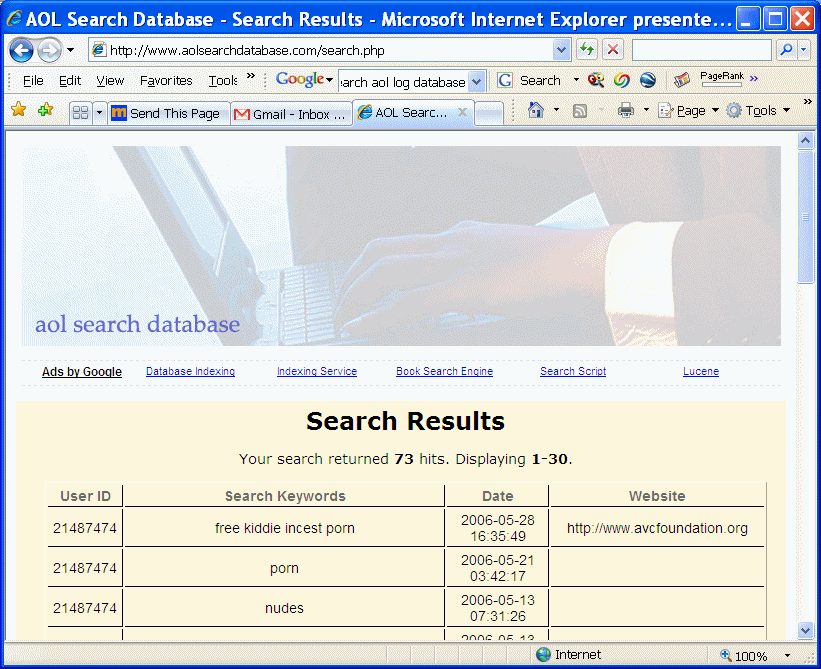
o here's what you do: search for something unsavory. For instance:


Click for full-size screen shot

We find, for instance, 43,206 people searched for "child porn." Now, do a new search, filtering only by a user number. You'll see all the searches that person did over a three month period. If you see enough disturbing searches, you'll conclude the searcher is more than just unsavory.

Here's what's going to happen: law enforcement officers at every level are mining this data right now for unsavory searches. When they find a pattern of worrisome searches -- user
2150654 seems very interested in how to make meth -- they'll search for clues to the identities of these searchers. (User 2150654 wants to buy a truck in Oklahoma.) If they can't find a person's identities in the search logs, they'll pursue a subpoena to make AOL cough up the screen name, using the disturbing search terms as probable cause.

In many cases, this will lead to arrests, maybe even successful prosecutions.

And then, watch law enforcement at all levels, from the Justice Department to your local sheriff, demand the ability to fish through search logs indiscriminately.

See http://www.aolsearchdatabase.com

A hard hat and heartfelt compassion - in 100 degree heat


Will have to explain this one later...

Tuesday, August 08, 2006

Official election results from Connecticut: the Secretary of State office is incompetent

Many of us have more than a passing interest in the U.S. Senate primary race in Connecticut. Many of us feel that Senator Lieberman, an honorable public servant, tossed his credentials as a Democrat when he filed to run as an independent if he lost in the primary.

So many of us are watching the Connecticut race carefully.

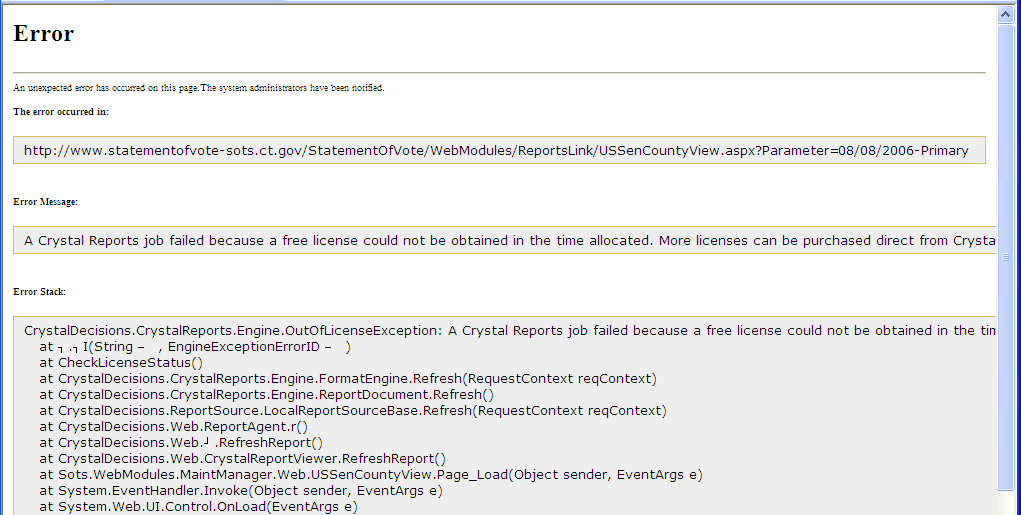
And the official elections Web site is melting down, a sad gelatinous goo of Crystal Reports gone bad. Most embarrassing of all, it appears that the Connecticut Secretary of State failed to acquire a license for the reporting software:

Click to see full-size screen shot

Please, pay no attention to the man behind the curtain.

Saturday, July 29, 2006

Who owns - or will own - this license plate?

Back in 1994 when I was working on my book, The Internet for Everyone: A Guide for Users and Providers, my wife bought me a vanity license plate, INTRNET.

A few years later, I proposed to Andy King, co-founder of Webreference.com, that we create The Internet License Plate Gallery. Andy came up with clever graphics including a Fifties Cadillac and stripes going past you on the highway, and we launched the site. Andy's since left Webreference, and sadly, it appears the site is languishing with no updates (though still providing ad revenue for Internet.com).

Now Michigan is all aflutter over Google opening a new presence in the state for its Adsense product. That got me to wondering: Who owns (or will own) this license plate?

Wednesday, July 26, 2006

Fascinating article on how users interact with Web sites

Andy King gave me a heads-up about a fascinating article posted on his Web Site Optimization site. I especially love this "heatmap" showing where users' eyes tend to travel when looking at the Google hit list. Graphical and empirical proof that the top of the hit list is an extremely precious place to be.


See:

Clickstream Study Reveals Dynamic Web

Saturday, July 22, 2006

Daddy! Daddy! They've got WeeFee!!!

We were heading into a restaurant in Traverse City, Michigan, the best breakfast joint in town, the Omelette Shoppe. A couple of families with young children was headed in right behind us.

One young lad, age 6 or so, was already excited but his eyes really lit up when he saw a banner above the entrance.

"Daddy! Daddy! They've got WeeFee!!!" he proclaimed.

And sure enough they did. I just didn't know the correct pronunciation.

American Express renames me: &$$htmBegin&$$

A payment notice from American Express appears to be addressed to me as &$$htmBegin&$$:


Click to see full-size image

Looking more closely, I see that it's some sort of a flag for a wrapper, a field for a content management wrapper that didn't get expanded properly at publication time.

We've all seen this sort of thing before, where a distributed database or mass mailing system makes a goofy substitution or fails to substitute the customer name for the generic field name. There's a funny folk song about material addressed to "Your State Name Here."

Over the years I've heard some hilarious examples:

  • My friend Mark Grebner, whose firm is the leading political mailing list service in Michigan, puzzled over why so many people have a surname of Usafret. What the heck ethnicity is that? He figured out that it's USAF (Ret.) -- a retired member of the Air Force.

  • My wife's friend Deb Biggs once got mail addressed to Ded Buggs.

  • And the all time winner of the trifecta, Mark Allen Knopper, at the time a network engineer for the Merit network, received mail addressed to Mirv Alien Knipper. Yup, all three of his names transformed. For years thereafter people called him Mirv.

I'd love to legally change my name to &$$htmBegin&$$ but like Spock I'm afraid you wouldn't know how to pronounce it.

Sunday, July 16, 2006

Our book on search analytics - competing with itself thanks to O'Reilly

Lou Rosenfeld and I are writing a book on search analytics -- how to exploit the gold mine of information that exists in the logs your local search engine compiles. Lou, co-author with Peter Morville of the best-selling O'Reilly title, Information Architecture for the World Wide Web, has launched his new publishing house, Rosenfeld Media, and this will be one of the first of its books in the area of improving the user experience.

We're really excited about the book. We're learning great things by interviewing some very smart people who work for leading search technology companies, or leading companies exploiting search analytics. Thanks to Lou's reputation and his extensive network of friends in the information architecture field, we're able to connect with wise folks who can teach us a lot.

Please check out the Web site for the book where we're discussing our learning process as we go:

http://www.rosenfeldmedia.com/books/searchanalytics

Now that's all great news... Here's a frustrating footnote. Last year Lou and I submitted a proposal to the noted computer publisher O'Reilly. We were still in discussions with them when they mailed me a contract! It took a little longer for Lou to receive his copy, but we hadn't agreed to write the book for them, and by then Lou had decided to proceed with his own imprint. We confirmed to O'Reilly that we wouldn't sign the contract and would publish elsewhere.

Imagine my surprise one day in April 2006 when, while merrily Googling away doing research for the book, I discovered you could already buy it! O'Reilly had assigned the book an ISBN -- 0596101910 -- and submitted it to the Amazons of the world as a soon-to-be-published book!

Click for full size image

Poking around a bit I found that Amazon.uk, Powell's, and several other outlets listed the book. Some sites even accepter pre-orders! At first this was mildly amusing.

On May 1, Lou politely asked a contact at O'Reilly (aka ORA) to excise the book from the publishing world's pipeline. We eventually received word that they would.

Now it's July 16, and the book now appears on more publishing outlets than it did on May 1. You can buy "our book" in Canada, the UK, Germany, and Japan. Powell's, the legendary bookseller in Portland, Oregon, has it.

This is more than a little bit frustrating, and no longer a bit amusing. As our real book moves closer to publication, the phantom title could cause serious confusion in the marketplace. ORA tells us that once they ship an ISBN out on a book industry network called Onix, it's hard to retract it from booksellers.

Regardless of whatever technical hurdles ORA faces in undoing this mess, it seems to me they are obliged to un-do what they've done -- promptly.

Click below to see the Japanese, UK, and German -- and US -- versions of the problem.


Wednesday, July 05, 2006

As American as strawberry pie


Linda' s strawberry pie -- delicious and prettier than fireworks....