David Pogue, who writes about computers for The New York Times, declares in his most recent column:
"White-collar types on both coasts have become addicted to the BlackBerry, thanks to its ability to display e-mail instantly as it arrives and to synchronize with your computer back at the office over the air."
Oh, so mo one uses Blackberries in the middle of the damn country? Does Blackberry offer no service other than on "both coasts"?
For decades the New York and LA media elites have been jealous of each other. The de facto detente they reached is to refer to, and to cover, "the coasts". This most arrogant formulation omits the middle of the entire country -- including the North Coast, the Great Lakes, home to thousands of miles of coastland and the greatest collection of fresh water on Earth.
Does Mr. Pogue assume that the Blackberry does not function in Chicago, home of Boeing executives? Does he postulate that the Blackberry does not operate in Memphis, home of Fed Ex? Does he forget that big oil executives work in Texas headquarters? Does Pogue suppose that a white collar employee of 3M, based in Minneapolis, is deprived of the opportunity to be among the Blackberry cognoscenti? Does he think that Warren Buffet, a billionaire who made his fortune out of simple propositions, could not have a Blackberry in Tulsa if he thought he needed one? (No doubt Buffet would rather drink a Coke or read the print edition of the Wall Street Journal instead of poking and peeking at a Blackberry.)
Adding irony upon irony: Research in Motion, or RIM, which invented and markets the Blackberry, is a Canadian company, based in Toronto. Not on the coasts Pogue refers to, but near the Great Lakes.
Please, drop your coastal arrogance.
Friday, September 08, 2006
Wednesday, September 06, 2006
Overloaded Google News links to tasteless Steve Irwin story parody
Prominently listed among the 3,462 articles about Steve Irwin, Google News offered this headline:
Stingray Apologizes for Crocodile Hunter Irwin's Death
 Click to see full-size screen shot
Of course, it links to a parody news site:

No doubt there are a lot less tasteful Steve Irwin jokes in the pipeline. I just don't understand why Google News includes parody sites in a news service. At the very least, Google should be transparent about which sites it includes and why. What are the criteria for inclusion?
http://www.laist.com/archives/2006/09/06/stingray_apologizes_for_crocodile_hunter_irwins_death.php
Stingray Apologizes for Crocodile Hunter Irwin's Death
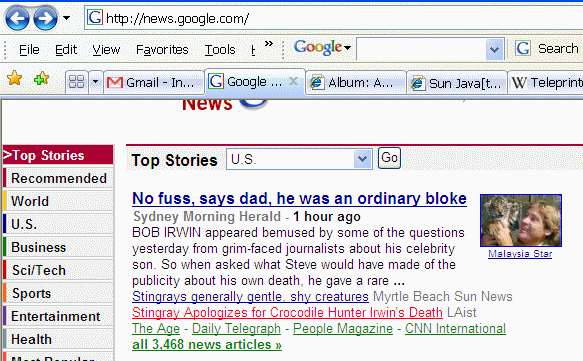 Click to see full-size screen shot
Of course, it links to a parody news site:
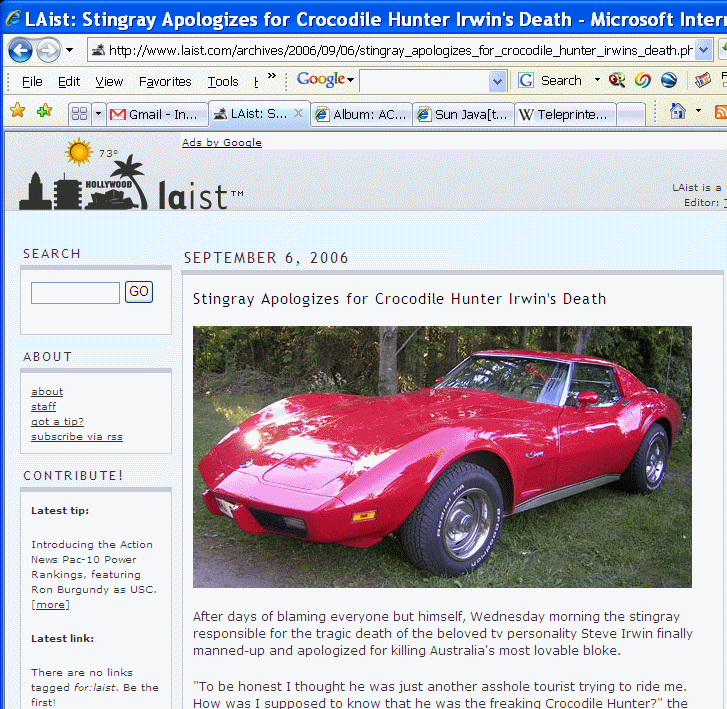
No doubt there are a lot less tasteful Steve Irwin jokes in the pipeline. I just don't understand why Google News includes parody sites in a news service. At the very least, Google should be transparent about which sites it includes and why. What are the criteria for inclusion?
http://www.laist.com/archives/2006/09/06/stingray_apologizes_for_crocodile_hunter_irwins_death.php


Monday, September 04, 2006
80 gig for 80 bucks - and tiny
Once upon a time it was amazing that disk storage cost a dollar a megabyte. Today I bought a disk drive that was the size of a PDA. It cost $90 for 80 gigabytes. That's 80,000 megabytes if you're paying attention.
It's a LaCie drive, USB powered, no need to carry an external power brick.

Dr. Lew Greenberg, retired director at my day job, recently told me that Moore's Law doesn't apply to disk; improvements in disk storage outpace improvements in semiconductors.
You can store an awful lot of stuff on an 80 gig drive that fits in your pocket. Expect much more corporate espionage and identity theft.
It's a LaCie drive, USB powered, no need to carry an external power brick.

Dr. Lew Greenberg, retired director at my day job, recently told me that Moore's Law doesn't apply to disk; improvements in disk storage outpace improvements in semiconductors.
You can store an awful lot of stuff on an 80 gig drive that fits in your pocket. Expect much more corporate espionage and identity theft.
Monday, August 28, 2006
Florida universities know how to execute an emergency plan
Every institution, including every university, should have a business continuity plan. Universities in South Florida are executing those plans right now, as Ernesto, either storm or hurricane, approaches.
Others can watch these universities execute these plans, as seen on the Web:


Others can watch these universities execute these plans, as seen on the Web:
Sunday, August 27, 2006
Columbia, please redirect without spanking me
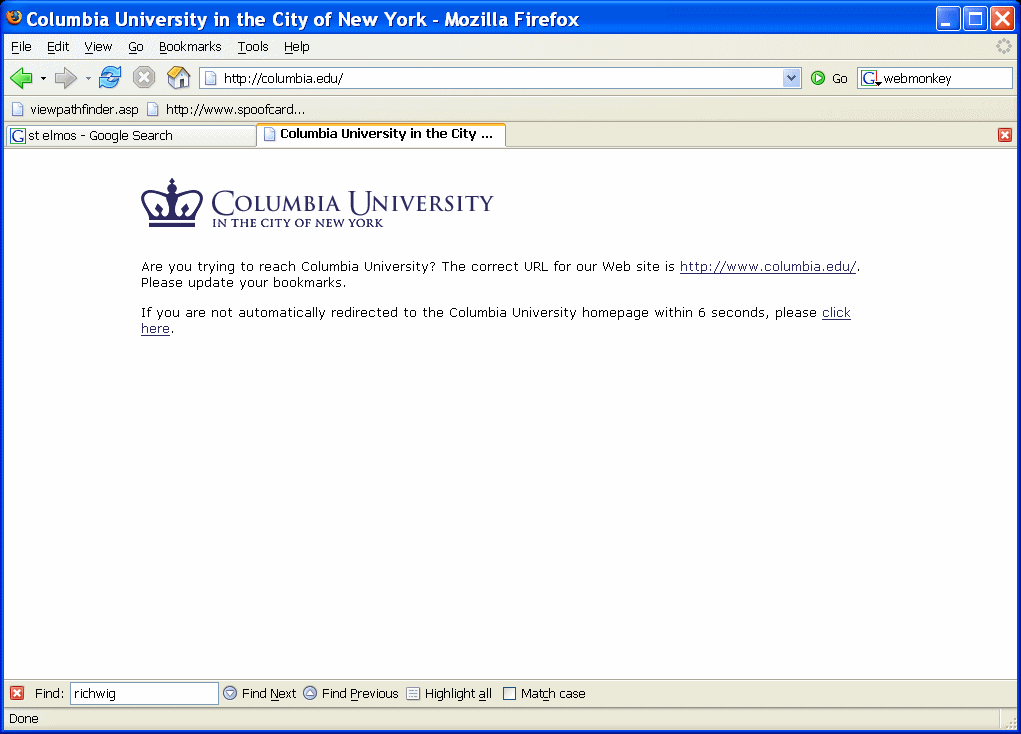 Normally I try not to complain about rank stupidity at a univerisity. When you work at a university, you know what crazy ideas committees come up with.
But when you find a truly goofy idea, it is hard to stay silent. Columbia University spanks you if you don't put www in front of their domain name. Go to Columbia.edu and they tell you that you are a bad boy for not putting www at the beginning of their URL.
Honestly, I should be kinder to Columbia, because their searchmeister implemented a Best Bets service inspired by MSU Keywords.
Best Bets
I attended “The Accidental Thesaurus: Enhancing Search Precision through Manual-Selected Best Bets” presented by Richard Wiggins at the IA Summit. Inspired as I was, I didn’t get around to implementing the same thing for Columbia until recently. Crunching a year’s worth of query logs from our Ultraseek server revealed much the same distribution curve that he found at Michigan State University.
(See Beyond the Spider: The Accidental Thesaurus(PDF))
My results:

From the IAwiki:
Best Bets
Pareto Principle
Zipf Distribution as one of various Statistical Laws
But please: C'mon, people, just redirect. In 2006, the world equates CNN.com and www.CNN.com.
Saturday, August 26, 2006

Lately I've been thinking a lot about what it must have been circa 1956 when professors and others yearned for a computer where they could perform scientific calculations.
You know, moving from pencil and paper, and slide rule, to a computer. These were not minor changes.
So I laughed when I stumbled on this photo from Internet Librarian last year:
The early days of computing were all about scientific calculations. This photo accidentally shows how much we take for granted.
Thursday, August 24, 2006
Monday, August 21, 2006
AOL forces its CTO out, and fires two unnamed employees
The chief technology officer for America Online, Maureen Govern, resigned in light of AOL's release of search logs showing activity for 650,000 plus customers over a recent 90 day period.
AOL's press release says that two other AOL employees were fired. My guess is that the two fired employees were Abdur Chowdhury (cabdur@aol.com) and Greg Pass (gregpass1@aol.com) of the AOL "Search and Navigation Group." They merely sought to publish an academic paper and contribute to the search log analysis community. I've e-mailed them; one mail bounced from the (former?) AOL account. My guess us they have better things to do than to answer press inquiries.
But they gave away too much data. Pass and Chowdhury should have understood that posting detailed logs of search sessions would reveal private information. Here's my coverage of this story for Information Today:
http://www.infotoday.com/newsbreaks/nb060814-1.shtml
But now The New York Times and others have weighed in. AOL is hurting, and this news came at a very bad time.
It would be very bad indeed if this case leads to legislation that outlaws search log analysis, which, used properly, simply helps people find things.
AOL's press release says that two other AOL employees were fired. My guess is that the two fired employees were Abdur Chowdhury (cabdur@aol.com) and Greg Pass (gregpass1@aol.com) of the AOL "Search and Navigation Group." They merely sought to publish an academic paper and contribute to the search log analysis community. I've e-mailed them; one mail bounced from the (former?) AOL account. My guess us they have better things to do than to answer press inquiries.
But they gave away too much data. Pass and Chowdhury should have understood that posting detailed logs of search sessions would reveal private information. Here's my coverage of this story for Information Today:
http://www.infotoday.com/newsbreaks/nb060814-1.shtml
But now The New York Times and others have weighed in. AOL is hurting, and this news came at a very bad time.
It would be very bad indeed if this case leads to legislation that outlaws search log analysis, which, used properly, simply helps people find things.
Sunday, August 13, 2006
Searching the AOL search logs - the implications
The researchers goofed. Although the log files didn't have AOL screen names, they did have a unique identifying number for each user. It only takes a few iterations to learn a lot about an individual -- in some cases, including their identity. AOL yanked the dataset but it was already mirrored worldwide.
An enterpsising Daniel Zhao of Mount Pleasant, Michigan, who tells me he is an 18 year old about to enter his sophomore year at Penn, quickly registered aolsearchdatabase.com on August 7, and soon thereafter he produced on the Web searchable database of the AOL search logs.
So here's what you do: search for something unsavory. For instance:
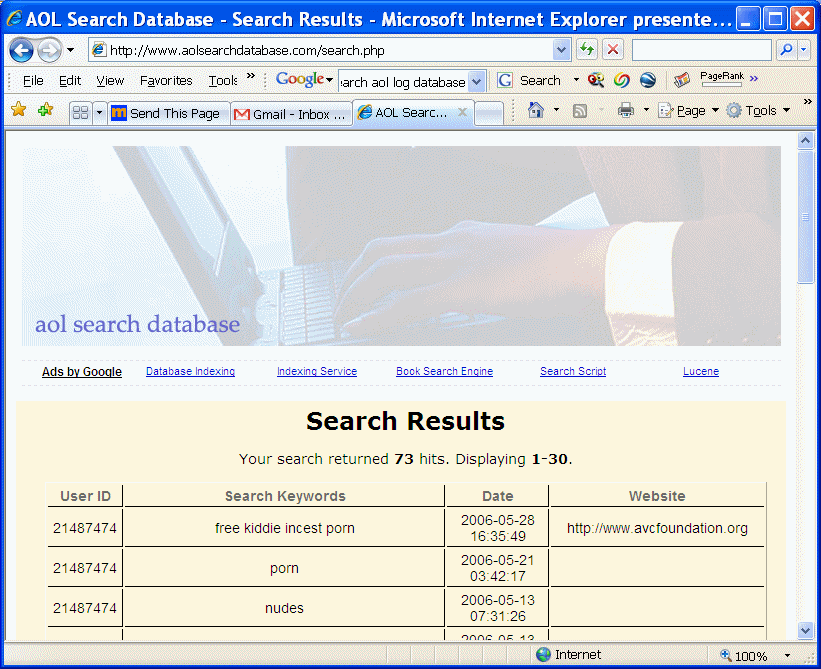 Click for full-size screen shot
We find, for instance, 43,206 people searched for "child porn." Now, do a new search, filtering only by a user number. You'll see all the searches that person did over a three month period. If you see enough disturbing searches, you'll conclude the searcher is more than just unsavory.
Here's what's going to happen: law enforcement officers at every level are mining this data right now for unsavory searches. When they find a pattern of worrisome searches -- user 2150654 seems very interested in how to make meth -- they'll search for clues to the identities of these searchers. (User 2150654 wants to buy a truck in Oklahoma.) If they can't find a person's identities in the search logs, they'll pursue a subpoena to make AOL cough up the screen name, using the disturbing search terms as probable cause.
In many cases, this will lead to arrests, maybe even successful prosecutions.
And then, watch law enforcement at all levels, from the Justice Department to your local sheriff, demand the ability to fish through search logs indiscriminately.
See http://www.aolsearchdatabase.com

Tuesday, August 08, 2006
Official election results from Connecticut: the Secretary of State office is incompetent
Many of us have more than a passing interest in the U.S. Senate primary race in Connecticut. Many of us feel that Senator Lieberman, an honorable public servant, tossed his credentials as a Democrat when he filed to run as an independent if he lost in the primary.
So many of us are watching the Connecticut race carefully.
And the official elections Web site is melting down, a sad gelatinous goo of Crystal Reports gone bad. Most embarrassing of all, it appears that the Connecticut Secretary of State failed to acquire a license for the reporting software:
 Click to see full-size screen shot
Please, pay no attention to the man behind the curtain.
So many of us are watching the Connecticut race carefully.
And the official elections Web site is melting down, a sad gelatinous goo of Crystal Reports gone bad. Most embarrassing of all, it appears that the Connecticut Secretary of State failed to acquire a license for the reporting software:
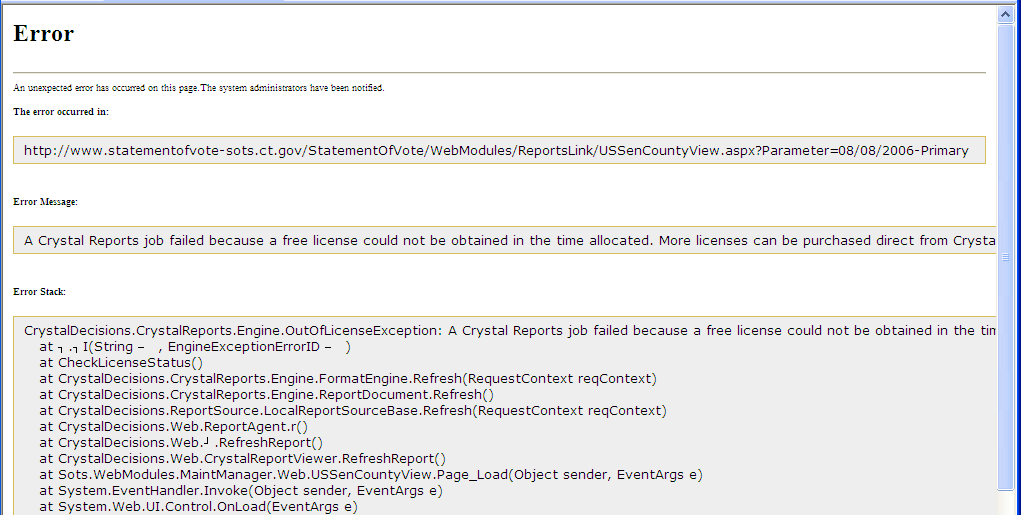 Click to see full-size screen shot
 Please, pay no attention to the man behind the curtain.
Saturday, July 29, 2006
Who owns - or will own - this license plate?
Back in 1994 when I was working on my book, The Internet for Everyone: A Guide for Users and Providers, my wife bought me a vanity license plate, INTRNET.
A few years later, I proposed to Andy King, co-founder of Webreference.com, that we create The Internet License Plate Gallery. Andy came up with clever graphics including a Fifties Cadillac and stripes going past you on the highway, and we launched the site. Andy's since left Webreference, and sadly, it appears the site is languishing with no updates (though still providing ad revenue for Internet.com).
Now Michigan is all aflutter over Google opening a new presence in the state for its Adsense product. That got me to wondering: Who owns (or will own) this license plate?

A few years later, I proposed to Andy King, co-founder of Webreference.com, that we create The Internet License Plate Gallery. Andy came up with clever graphics including a Fifties Cadillac and stripes going past you on the highway, and we launched the site. Andy's since left Webreference, and sadly, it appears the site is languishing with no updates (though still providing ad revenue for Internet.com).
Now Michigan is all aflutter over Google opening a new presence in the state for its Adsense product. That got me to wondering: Who owns (or will own) this license plate?

Subscribe to:
Posts (Atom)