One measure of a Web site's popularity might be how it melts down when you visit it. Web sites tend to fail in strange and mysterious ways when overloaded. If you visit the official Web site for Barack Obama right now, you see a very artful photo of Barack and his family. If you click through, you see this:
Warning: mysql_pconnect() [function.mysql-pconnect]: Host 'web10.colo' is blocked because of many connection errors; unblock with 'mysqladmin flush-hosts' in /home/obama/htdocs/ext/adodb/drivers/adodb-mysql.inc.php on line 376Warning: mysql_pconnect() [function.mysql-pconnect]: Host 'web10.colo' is blocked because of many connection errors; unblock with 'mysqladmin flush-hosts' in /home/obama/htdocs/ext/adodb/drivers/adodb-mysql.inc.php on line 376Warning: mysql_pconnect() [function.mysql-pconnect]: Host 'web10.colo' is blocked because of many connection errors; unblock with 'mysqladmin flush-hosts' in /home/obama/htdocs/ext/adodb/drivers/adodb-mysql.inc.php on line 376Warning: problem running db_change: Host 'web10.colo' is blocked because of many connection errors; unblock with 'mysqladmin flush-hosts' in /home/obama/htdocs/config/blue_config_autosetup.inc.php on line 25Fatal error: error on SELECT for config data - does table exist? in /home/obama/htdocs/config/blue_config.inc.php on line 258
Tuesday, January 29, 2008
Thursday, December 06, 2007
Civilized Wi-Fi in public spaces, versus Caesar's Palace

In November I gave a talk on Web search analytics in Barcelona, and this week, in Las Vegas.
In Barcelona we were at a hotel called the AB Skipper. Their approach was totally civilized. Free Wi-Fi (and Ethernet) in all the rooms, and free Wi-Fi throughout the hotel.
The conference was at Caesar's Palace. They charged $13.99 per 24 hours of Wi-Fi. They offered no free Wi-Fi in public spaces or conference rooms.
I write at the McCarran Airport in Las Vegas. They provide free Wi-Fi throughout the airport. They even advertise it.
When I connect in Minneapolis and in Detroit, the airports will charge for Wi-Fi.
I'm not a Utopian who believes that Wi-Fi will set you free. I think, for instance, that attempts for cities to paint the whole town wireless were doomed to failure. (And in fact many have failed.)
But I do think it makes much more sense to follow the model of the AB Skipper and of McCarran than to attempt to squeeze extra dollars of people stuck on your premises. On the way to the airport I passed a Motel 6 that had a banner offering free Wi-Fi. Major hotels and airports should offer Wi-Fi just as they provide electricity, and make their money off the bars and not amenities people have come to expect.


Sunday, October 28, 2007
Yes, Mr. Dvorak, Windows can't count, but Mac can't either

John Dvorak recently wrote about how poor Windows is at multitasking. For instance, you're writing a Word document while in the background copying a huge file, but your keystrokes don't get priority.
He also complained that Windows is goofy about calculating how long it wil take for that file copy to complete. Windows seems unable to make a reasonable calculation. Its first guess as to time is often way off, and Windows fails to adjust to reality during the copying process.
It's a valid complaint, one that I shared with folks at work. But it's not just a problem with Windows. My colleague Davin Granroth sent me this jewel -- Stuffit on MacOS thinks it'll be centuries before it'll finish decompressing a file.
Sunday, October 21, 2007
Extremely targeted marketing by Orbitz
Last week I purchased tickets for a trip to Barcelona. I researched fares using Northwest.com, Orbitz, and other providers. Today, days later, I was looking up information about, of all things, the Superman comic saga, and the banner ad at About.com remembers my recent searches:

Hmm, they used to say "just because you're paranoid doesn't mean they're not out to get you." I have not done any searches related to Barcelona in days. So About.com picks up an Orbitz tracking cookie days later and offers me great fares.
For weeks I was quoted fares of $1000 or more. Then suddenly a fare of about $750 was offered. I do wonder if the NWA and Orbitz computers take note of how many times you've looked up fares, and, like a mule trader of old, from time to time offer a special deal.

Hmm, they used to say "just because you're paranoid doesn't mean they're not out to get you." I have not done any searches related to Barcelona in days. So About.com picks up an Orbitz tracking cookie days later and offers me great fares.
For weeks I was quoted fares of $1000 or more. Then suddenly a fare of about $750 was offered. I do wonder if the NWA and Orbitz computers take note of how many times you've looked up fares, and, like a mule trader of old, from time to time offer a special deal.
Saturday, July 28, 2007
Dear Jane letter to the iPhone
Hilarious stuff. More than one reviewer wants to love his lovely iPhone, but it just isn't going to work out. I kid my friend and colleague Trevor that he's driving a Ferrari on a dirt road.
Don't get me wrong; I think the iPhone is an absolutely amazing piece of engineering. In 2007 it is 100 times more than the Newton, and it makes my beat-up Treo 650 a dinosaur. But listen to two iPhone lovers whose love has altered when it alteration found:
See:
http://machinist.salon.com/blog/2007/07/13/return_iphone/
...and...
I'm Dumping the iPhone
http://www.huffingtonpost.com/chris-case/im-dumping-the-iphone-_b_57748.html
Don't get me wrong; I think the iPhone is an absolutely amazing piece of engineering. In 2007 it is 100 times more than the Newton, and it makes my beat-up Treo 650 a dinosaur. But listen to two iPhone lovers whose love has altered when it alteration found:
See:
http://machinist.salon.com/blog/2007/07/13/return_iphone/
...and...
I'm Dumping the iPhone
http://www.huffingtonpost.com/chris-case/im-dumping-the-iphone-_b_57748.html
Dearest iPhone,
I must admit that things between us had a great and beautiful start. I
was in love with your bag before I even saw you. And when I logged onto iTunes
for easy activation, I was enthralled with your sleek beauty. Remember our first
night together? We stayed up all night getting to know each other and then you
went to sleep in my arms. God, you were gorgeous.
Yet, a few weeks later, it seems that none of the promises that we
planted in those fields of hope has flourished. In fact, after a brief and
torrid first few days together, things have gone steadily downhill, making me
realize that it's best to sever ties now while we still both have our dignity
and I have not smashed you on the sidewalk in frustration.
Unfortunately, simply put, it just didn't happen for us. Nothing
remains of what looked like a growing love, besides some memories
and a few dozen photos that are now safely tucked away in my iPhoto, images
of a love that once burned white hot, but now are just a flicker of sadness.
How did everything lose its enchantment so quickly? All that remains is a
bitter taste of what once tasted like such sweet candy.....
Sunday, July 01, 2007
Twin heartbeats: watching a multi-core processor at work
Recently I started using a Lenovo (nee IBM) Z61t laptop, replacing my late lamented X40. The new computer sports a dual core Intel processor. This means it sort of has two CPUs.
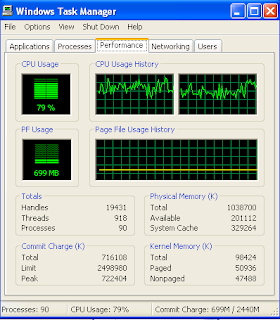
It's fun to watch the two processors vie for work to do when a single-threaded task is at hand. I do a lot of work crunching search logs, and when you exceed about 32,000 rows in an Excel spreadsheet, things begin to bog down. Even gathering the data in a large Internet Explorer window can take a lot of CPU and a lot of real time. If you are running one single-threaded program, Windows reports your CPU as 50% or so until the task completes. The Windows Task Manager shows this in action. The "extra" core of the processor is available to handle other tasks, and the work appears to be divided equally between the two:
 Click to see full-size image
If you're running more than one app, or if the app you're running is multi-threaded, then both halves of the CPU can do useful work. For instance, when I copy 200,000 rows of data from IE to Excel, the CPU runs at close to 100%.
It's fun to watch the two processors vie for work to do when a single-threaded task is at hand. I do a lot of work crunching search logs, and when you exceed about 32,000 rows in an Excel spreadsheet, things begin to bog down. Even gathering the data in a large Internet Explorer window can take a lot of CPU and a lot of real time. If you are running one single-threaded program, Windows reports your CPU as 50% or so until the task completes. The Windows Task Manager shows this in action. The "extra" core of the processor is available to handle other tasks, and the work appears to be divided equally between the two:
 Click to see full-size image
If you're running more than one app, or if the app you're running is multi-threaded, then both halves of the CPU can do useful work. For instance, when I copy 200,000 rows of data from IE to Excel, the CPU runs at close to 100%.
My friends Chuck Severance, who literally wrote the book on high performance computing, and Bill Punch, who heads the High Performance Computing Center at Michigan State, understand all this full well. For me, an amateur observer of the end of Moore's Law and our multi-processor future, it's fun to watch.
Wednesday, June 06, 2007
Ladies and gentlemen, the amazing book digitizing machine
Last week I saw the incarnation of an amazing book digitizing machine, something that my friend Mark Grebner and I dreamed of circa 1999. This by no means is not to say that others did not imagine such a thing before us; of course they did. But it was exhiliarating to see the actualization of something so important.
Every year in June I join my wife at her professional association meeting, the Special Libraries Association, or SLA. Attendees include some smart folks: science librarians, law librarians, medical librarians, and more.
Like many conferences, SLA offers presentations and a trade show. At this year's trade show in Denver I was delighted to see this:

Every year in June I join my wife at her professional association meeting, the Special Libraries Association, or SLA. Attendees include some smart folks: science librarians, law librarians, medical librarians, and more.
Like many conferences, SLA offers presentations and a trade show. At this year's trade show in Denver I was delighted to see this:

This is way, way, cool, even astonishing. The device has two digital SLRs aimed across each other at 45 degree angles, so as to shoot the even and odd pages at once. After the pages have been shot digitally, a robotic arm moves over, and a gentle vacuum pulls the right-hand page up and folds it over. Here's a short movie I took showing how this gizmo inhales a digital copy of a book
The company selling this device, Kirtas, is not the one serving the Google Book digitization effort. But the concept is the same, and Kirtas has a number of library customers who are scanning precious collections for preservation.
While I marveled at this device last week, Al Gore was about 400 feet away signing 500 copies of his latest book. I implored an SLA official to bring the former Vice President to see this, gizmo, as Gore once told an allegory of a schoolgirl in Carthage, Tennessee benefitting from a digital Library of Congress. Alas, his path that Sunday evening was scripted by Secret Service and event obligations. I'm sure Al Gore would've loved to see in action a device that can scan an entire book in minutes.
Mark Grebner has used consumer-grade digital cameras to digitize voter records for over 7 years now. The Kirtas device uses high-end D-SLRs to do the same, at much higher resolution, but the concept is the same.
Sunday, June 03, 2007
Surgical masks when you fly?
Saw an unusual sight on my first flight since the idiot lawyer from Atlanta flew to and from Europe despite his TB infection: a guy in front of me wore a surgical mask the entire trip:

It could be he has a pre-existing condition, but my guess is this fellow feared risk of TB. That, of course, would be innumeracy: the odds that someone as selfish and stupid as Andrew Speaker are next to you on the plane are infinitesimally small.
Back during SARS you saw a fair number of people in airports wearing masks. That wasn't innumeracy; the disease was highly communicable and did reach North America. If or when Avian Flu hits, it will be strange to see everyone walking the streets wearing masks. But strange sights will be the least of our worries.

It could be he has a pre-existing condition, but my guess is this fellow feared risk of TB. That, of course, would be innumeracy: the odds that someone as selfish and stupid as Andrew Speaker are next to you on the plane are infinitesimally small.
Back during SARS you saw a fair number of people in airports wearing masks. That wasn't innumeracy; the disease was highly communicable and did reach North America. If or when Avian Flu hits, it will be strange to see everyone walking the streets wearing masks. But strange sights will be the least of our worries.
Friday, May 25, 2007
Mid 90s view of the future Web: cable modems, and the insights of John Naisbitt
It was the mid 1990s. The awesome possibilites of a future broadband Internet were before us. We introduced the Web to a famous futurist, and reported the dreams of how cable modems and content deals would transform the world.

In October 1995 my friend John Liskey arranged for Chuck Severance and me to interview some impressive folks at the Midwest Cable Show in Indianapolis. We interviewed the famed author of Megatrends, John Naisbitt. We had a cable modem set up at the show so we could demonstrate the future world of residential broadband. Naisbitt had been out of the country, in Asia, researching a book. It's my impression that he saw the Web for the first time via that cable modem.

Besides Naisbitt, I interviewed an engineer explaining a radical new device that provided Internet access to the home at 10 megabits per second. Dr. David Walker of the late, lamented Digital Equipment Corporation (DEC) described the cable modem they offered at the time. Just a few months earlier,Liskey had a cable modem installed at my house; thus since summer 1995, making me, I claim, one of the first few hundred people in the country with residential broadband. (I have no way to verify this claim.) Dr. Walker gave the example of finding Beatles outtakes and bloopers on the Net, and how broadband could bring multimedia to the home. Looking back, he accidentally predicted both YouTube and RIAA lawsuits.
David Coles spoke optimistically to Chuck about @Home, TCI's venture at the time to deliver content over broadband to homes and small businesses.
Lo how the world has changed.
TCI is now long gone, devoured in the many mergers of the dot com era. @Home is a footnote in the history of broadband. And my Comcast cable modem in the basement offers service at a fraction of the speed serving our house in 1995.
Hmmm.... What is John Naisbitt thinking about today?
Check out the video, a wistful window into the excitement and anticipation we all felt in the 90s about the future of the Internet.

In October 1995 my friend John Liskey arranged for Chuck Severance and me to interview some impressive folks at the Midwest Cable Show in Indianapolis. We interviewed the famed author of Megatrends, John Naisbitt. We had a cable modem set up at the show so we could demonstrate the future world of residential broadband. Naisbitt had been out of the country, in Asia, researching a book. It's my impression that he saw the Web for the first time via that cable modem.

Besides Naisbitt, I interviewed an engineer explaining a radical new device that provided Internet access to the home at 10 megabits per second. Dr. David Walker of the late, lamented Digital Equipment Corporation (DEC) described the cable modem they offered at the time. Just a few months earlier,Liskey had a cable modem installed at my house; thus since summer 1995, making me, I claim, one of the first few hundred people in the country with residential broadband. (I have no way to verify this claim.) Dr. Walker gave the example of finding Beatles outtakes and bloopers on the Net, and how broadband could bring multimedia to the home. Looking back, he accidentally predicted both YouTube and RIAA lawsuits.
David Coles spoke optimistically to Chuck about @Home, TCI's venture at the time to deliver content over broadband to homes and small businesses.
Lo how the world has changed.
TCI is now long gone, devoured in the many mergers of the dot com era. @Home is a footnote in the history of broadband. And my Comcast cable modem in the basement offers service at a fraction of the speed serving our house in 1995.
Hmmm.... What is John Naisbitt thinking about today?
Check out the video, a wistful window into the excitement and anticipation we all felt in the 90s about the future of the Internet.
Friday, May 11, 2007
The peril of thinking that Gmail (Beta) is in production

For the last few hours, I've been unable to access my Gmail account. Error 502, whatever that is. I'm on deadline to finish an article, and some essential quotes are locked in my inaccessible Gmail Inbox.
Right up there on the Gmail logo, it says "Beta". They gave me fair warning. But I treat it as production, my total e-mail solution, a service I can trust.
My bad.

How many people think of Gmail as an industrial-quality, trustworthy, production service? What are Google's criteria for taking this product, introduced in April 1994, out of beta? When they do, what level of service can we expect?
Wednesday, May 09, 2007
Logistics conundrum: how do you evacuate a zoo?
IT folks spend a lot of time doing disaster planning, thinking through various scenarios, writing plans, and testing those plans. At my Day Job at Michigan State, my colleagues just installed some MSU servers at Penn State so that MSU can have a Web presence even if lots of technology in East Lansing gets wiped out.
Right now a fire in Griffith Park has the zookeepers worried. It's not immediately threatening to zoo, but yesterday they evacuated the humans. They said they considered evacuating the animals but decided not to.
I don't understand the logistics. How the hell do you evacuate the animals in a zoo? Build a land ark?
Does a large zoo have enough trailers and cages to hold all, or even a substantial fraction, of its animals?
Where would you take them? How would you care for them?
Right now a fire in Griffith Park has the zookeepers worried. It's not immediately threatening to zoo, but yesterday they evacuated the humans. They said they considered evacuating the animals but decided not to.
I don't understand the logistics. How the hell do you evacuate the animals in a zoo? Build a land ark?
Does a large zoo have enough trailers and cages to hold all, or even a substantial fraction, of its animals?
Where would you take them? How would you care for them?
Sunday, May 06, 2007
Facebook polemic: Flash as pamphleteer medium
Bill Moyers compares today's bloggers to the pamphleteers of the American Revolution. I think you could describe what I call the Flash polemic the same way. The style involves a professional-sounding, measured narration over words and images moving about the screen. Here's an example:

It's not just a polemic; it's a conspiracy theory involving the CIA, BBN, and DARPA.
I'm not sure I buy the conspiracy theory but I think the format is compelling. It's longer than an issues ad but it's shorter than a documentary. The production values are better than, say, a spot on local television, and much better than much of what you see on YouTube.
We'll see much more of this new form, I think.
http://www.albumoftheday.com/facebook/
It's not just a polemic; it's a conspiracy theory involving the CIA, BBN, and DARPA.
I'm not sure I buy the conspiracy theory but I think the format is compelling. It's longer than an issues ad but it's shorter than a documentary. The production values are better than, say, a spot on local television, and much better than much of what you see on YouTube.
We'll see much more of this new form, I think.
http://www.albumoftheday.com/facebook/
Subscribe to:
Posts (Atom)