Wednesday, August 31, 2005

Helping Katrina's homeless with information: merge Google Earth with new aerial photos

NPR just broadcast a poignant interview with a woman whose home is near where one of the levees broke. She expects it will be days or weeks before she and her family know the status of her house.

Click to see full-size image.

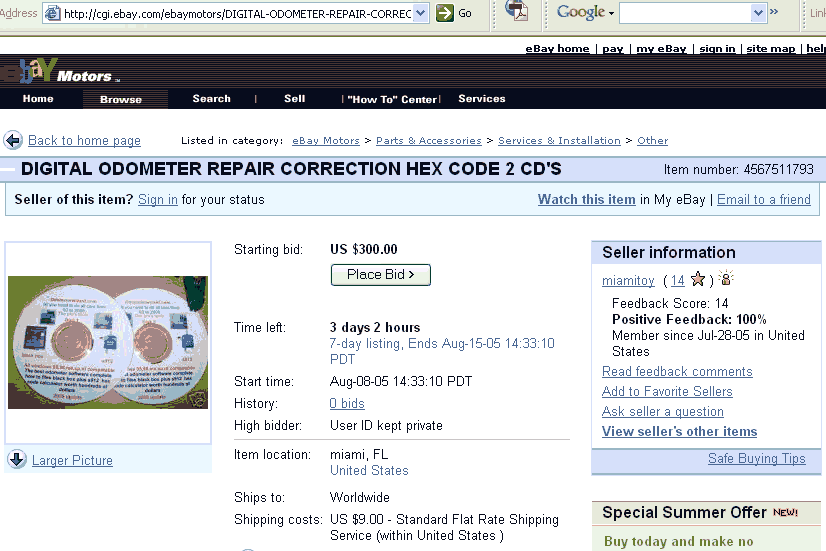
Google Earth offers detailed historical imagery of New Orleans, Mobile, and the Mississippi Gulf Coast, geocoded by street address. If the USGS, the military, or NASA took new aerial photos now, its hould be trivial to map the new photos against the old. A person could enter a street address and see what the property looked like before Katrina, and what it looks like now.

There may be over a million people who desperately want to know what their house or apartment or business looks like now. This would allow any refugee who can get to a Web browser to find out whether their home is rubble or at least superficially intact.

Use of geocoded data could even aid in rescue and recovery immediately. Louisiana Governor Blanco said today "We know people are trapped in their attics. We're trying to get them out now. I'll tell you something: Addresses mean nothing now because street signs are underwater." Given a street address and a precise GPS receiver, you could send a helicopter to within a few hundred feet of any given street address.

Gmail ups the invitation count to 100

Suddenly I've got 100 Gmail invitations to give out:


This is up from 50. A lot of people speculate that Google will eventually open up Gmail to work like Hotmail, Yahoo Mail, or any other competing free e-mail service. Want to open a new account? Just go to Hotmail.com and sign up; no invitation required.

I think there's a chance they will stick with the invitation model indefinitely. In an odd way, it helps foster a community of Gmail users. You have to find a Gmail pal to get started -- and many of us are Gmail evangelists, so that may not be a barrier for many people.

Maybe Google prefers the invitation model. At 2546 megabytes and growing, they've got to worry about people using their Gmail account as a storage vault.

I still think Google is capturing data as to how the invitations spread, and which service provider they poach customers from. (To accept an invitation, you click on a message sent to your current e-mail account.) I'd love to see a visualization of the spread of Gmail across the globe.

Tuesday, August 30, 2005

Why should TV anchors blog when they could be reporting?

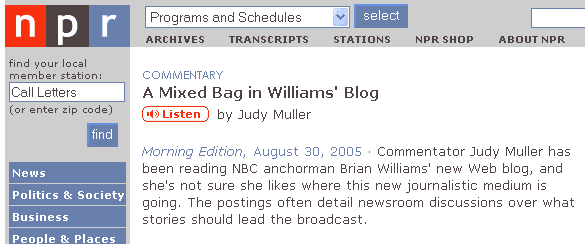
An interesting, and timely, piece aired on NPR this morning. Journalism professor Judy Miller noticed that Brian Williams, the new NBC Nightly News anchor, maintains a blog in which, among other things, he reports disputes in the NBC News division over what to cover each night.
Click to see full-size screen shot

Miller muses that Williams might better spend his time reporting the news, than on reporting on the process of reporting on the news.

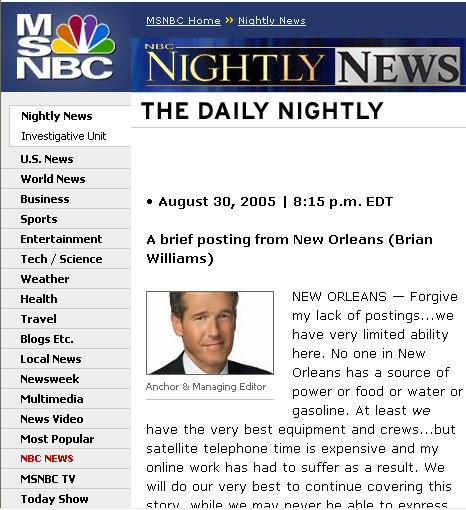
Well, now, Brian Williams and other reporters are in New Orleans, reporting on the devastation from Katrina. His most recent blog entry is from tonight, apologizing for the lack of recent blog entries:


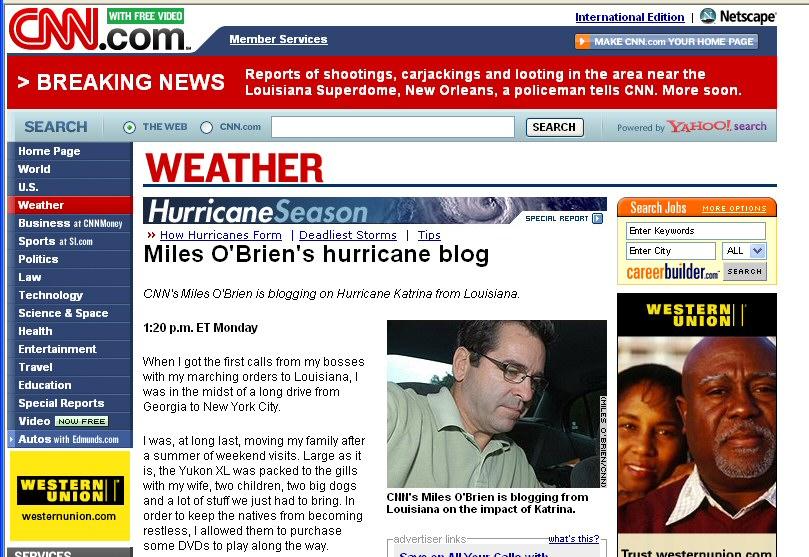
Tonight, CNN's news crawl at the bottom of the screen urges people to go to CNN.com to read reporter Miles O'Brien's "hurricane blog." Go there, and you find he hasn't posted since Monday mid-day:


You can't blame Williams or O'Brien for failing to update their blogs from a city that has no electricity, has little or no cell phone service, and is 80% under water.

But Miller asks a trenchant question: why bother? Why not concentrate on your day job, reporting on television for millions of viewers who want to know what's happening?

Miller's commentary is at: http://www.npr.org/templates/story/story.php?storyId=4823307

Shoot, don't let people under that chute

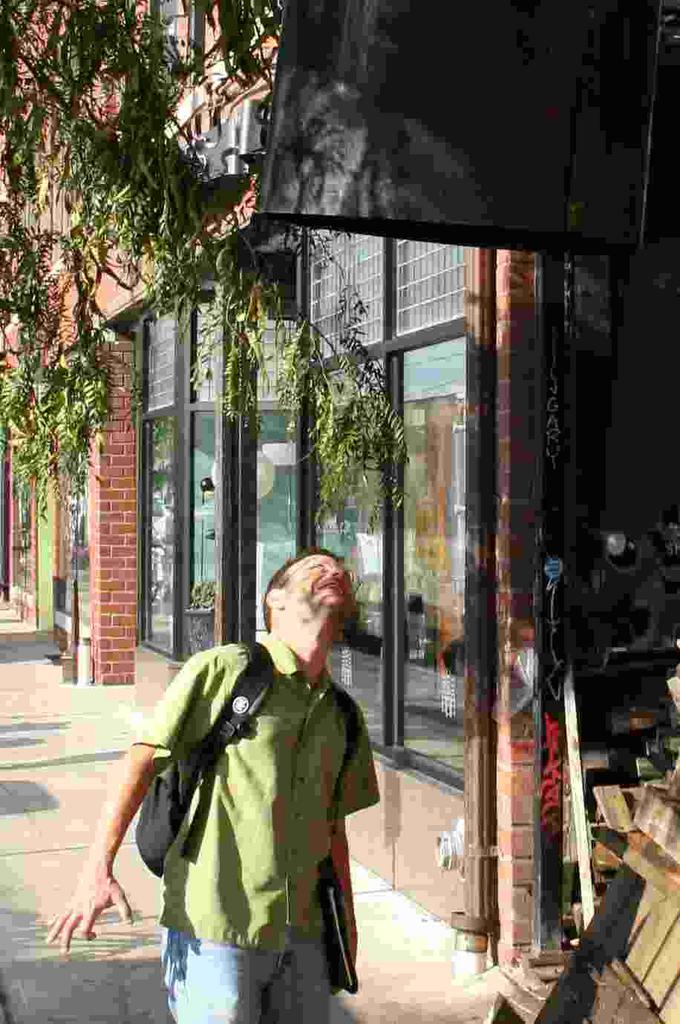
You know how construction firms use chutes to dispose of debris when they gut an upstairs floor of a building? I encountered such a chute in Ann Arbor yesterday. To my surprise, though, they hadn't blocked it off to keep someone from standing right under it. When I pointed this out to my friend Lou Rosenfeld, of course he rushed to ... stand right under it.

Click to see full-size images


I know, a pretty silly tale on a day when dozens died under the wrath of Hurricane Katrina. But there is a link: safety codes exist for a reason. In South Florida, new homes are required by code to be able to withstand hurricane winds. Katrina apparently killed 30 or more people in Biloxi when an apartment building collapsed. I wonder what the local codes require there?

Construction firms and workers often resent safety rules. Recently a commons area in a building in Lansing collapsed -- just fell into rubble -- on a sunny warm day. Thank God, it happened on a weekend, and the building was empty. If it had happened on a weekday, people would have died. The Lansing building inspectors declare that they won't let people occupy the repaired building until it's safe. But, ipso facto, they already let people occupy the building when it wasn't safe.

Ann Arbor, put some construction fence around that site. And Lou, don't hang out under that chute.

Friday, August 26, 2005

News anchors confuse "people" with "customers"

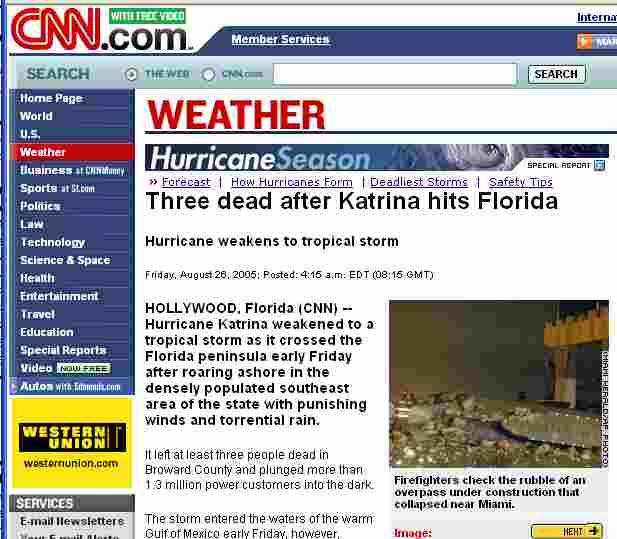
CNN just made the same mistake twice within one minute: they reported on the number of "people" without electricity, when they meant to report on the number of customers who lack power.

On "CNN Daybreak," the anchor intoned ominously that "1.3 million people in Florida are without power." She then moved to California, where rolling blackouts have caused power outages. Again, she said how many "people" are without power.

Get a clue, CNN. Electric utility companies count customers, not people. Customers are homes and businesses. If Florida Power and Light counts 1.3 million customers without power, the number of people in the dark is quite a bit higher.

Click to see full size screen shot.

What mystifies me is why news outlets make this same mistake over and over again -- after every hurricane or snowstorm.

Wednesday, August 24, 2005

When a hurricane takes over a university home page

All enterprises sweat over the home page. They should: Jakob Nielsen says your home page is the most precious real estate on earth.

Universities are no different than Fortune 500 companies. They worry endlessly about links, labels, images, and the entire "snap" of the home page.

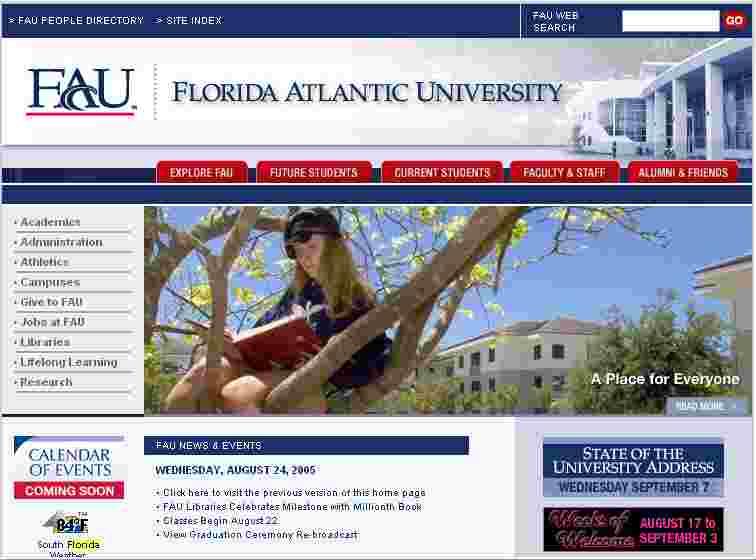
So what do you do if you're a large university in South Florida, and a tropical storm -- or a hurricane -- is headed your way? Consider the home page of Florida Atlantic University, as cached by Google:


Now suppose you are an administrator - perhaps the president - of Florida Atlantic University.

There's a serious storm heading your way:


There's a pretty good chance a really serious storm will hit your campus. It might wipe out buildings. Hell, it might kill people.

So what do you do? Hold classes as usual? Probably not. How would you explain your choice to the parent of a dead student who watches those storm tracking maps on the Weather Channel? So you shut down classes until the storm passes.

Now, how do you communicate this? Obviously you issue press releases. You talk to the media. But how do you use the university's Web site to communicate the closures, as well as links to other campus resources, and to trusted national sites?

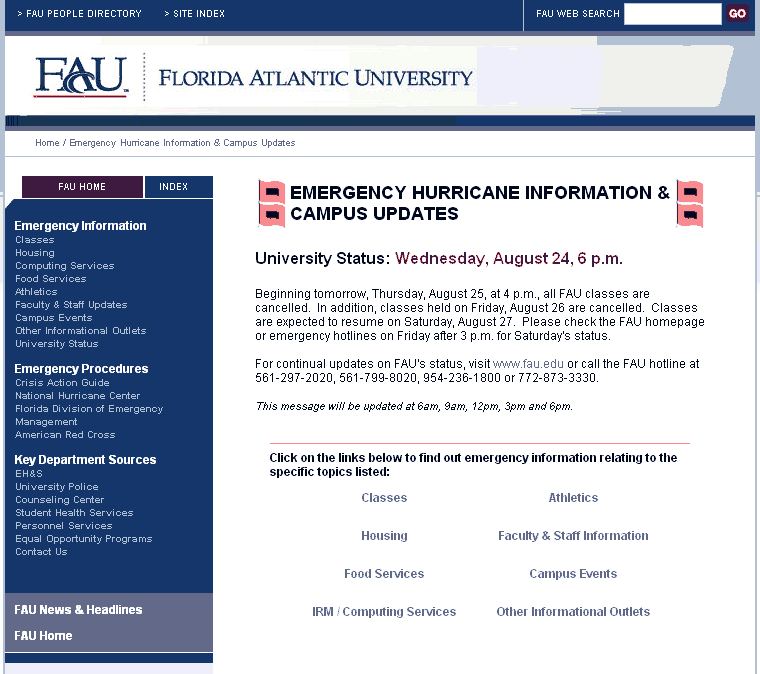
FAU chose to repurpose the entire university home page to handle the event:

Click to see full-size screen shot.

By choosing to hijack the entire architecture of the home page, the university decided that it was better to serve the information needs of current student, faculty, and staff, to the exclusion of prospective students, alumni, friends, and the public.

That might be the right decision, given the circumstances. A storm is on its way, and it may wipe out a large chunk of the campus. We have to serve the people who belong to the university community right now. Makes sense.

Or it might be the wrong decision. Maybe they should offer a prominent link to a page that offers storm information and advice for the current community, leveraging campus and other sources. Leave the university home page (mostly) intact, and offer a very visible link to resources for the crisis.

I honestly don't know the right answer.

But I do know that before, during, and after an emergency, people expect the enterprise home page to deliver current, timely, and useful information.
Google Talk: the desktop invasion continues

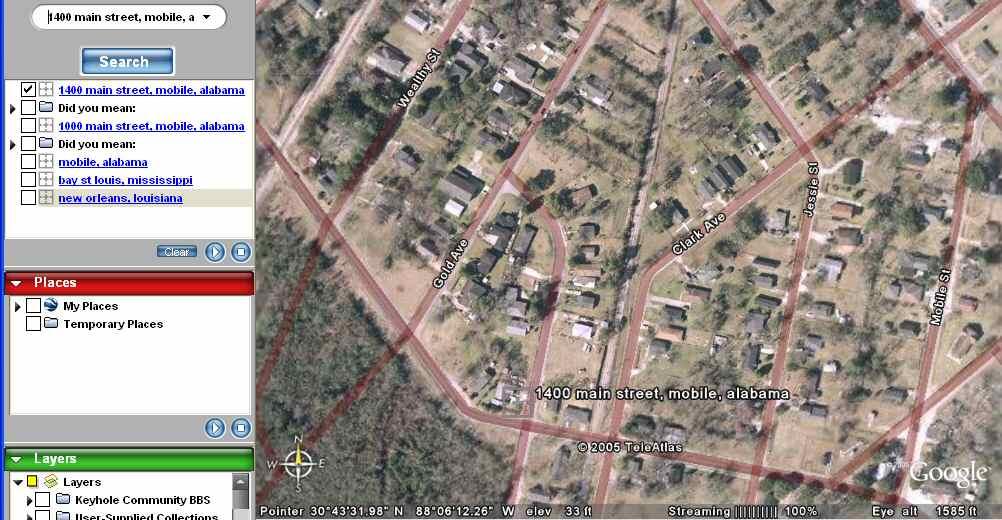
Google launched the rumored instant messaging tool, Google Talk, overnight. Some sharp-eyed Google watchers had noticed the domain talk.google.com was in service. And sure enough, there you will find:
Click to see full-size screen shot.

Google Talk integrates with the other tool Google announced this week, Google Desktop 2.

It won't be long before they offer word processing, spreadsheet, presentation software -- a networked office suite.

Wednesday, August 17, 2005

Can a typo in a URL cost you millions of dollars?

For years, Northwest Airlines has offered cheap deals every Wednesday. Savvy travelers can snap up a weekend getaway or other deal. Economists would love it: NWA fills empty seats, and customers get a bargain.

This week's deal offered a link with a typo:

Click to see full-size.

The URL that Northwest offered was:

visithttp://nwemail.nwa.com/W7RT04915C3FB90B322683DA087FE0

Obviously someone accidentally munged a bit of text -- "visit" -- with the URL prefix of "http". If you clicked on the link, you just got an error message. Of the millions of people who subscribe to NWA's Wednesday deals list, you've got to expect that thousands clicked on the link, and said "Oh, it's dead Jim" and moved on to some other surfing activity.

In other words, that little typo cost Northwest thousands of sales.

So you have to wonder:

  • I wonder how many thousands of customers gave up when their click on this URL failed?
  • I wonder how many seats on airplanes will be empty this weekend because of this typo?
  • I wonder how many millions of dollars NWA lost because of this mistake?
  • I wonder what changes in Web publishing procedures NWA will, or will not, now undertake?

Think about it: a typographical error could cost a company millions of dollars, and could keep thousands of people at home instead of at beach or mountain.

Monday, August 15, 2005

The City of New York

David Letterman likes to say "the town so nice, they named it twice."

New York, New York. (Cue Sinatra.)

New York City.

NYC.

But does anyone call it "the city of New York"???

While reviewing major university Web sites, I was surprised to see that Columbia University uses a name for NYC that I've never seen before:

Columbia University - In the city of New York

My guess is that the Columbia Web Committee debated "what should our tagline be" endlessly and came up with a phrase that no one -- whether native or elsewhere -- ever thinks or says when they think of New York City.

I bet they could have come up with a better tagline. Without even thinking more than a minute, I propose "Academic excellence in the heart of New York City"

Sunday, August 14, 2005

Finally! Validation from an authority -- the highway department

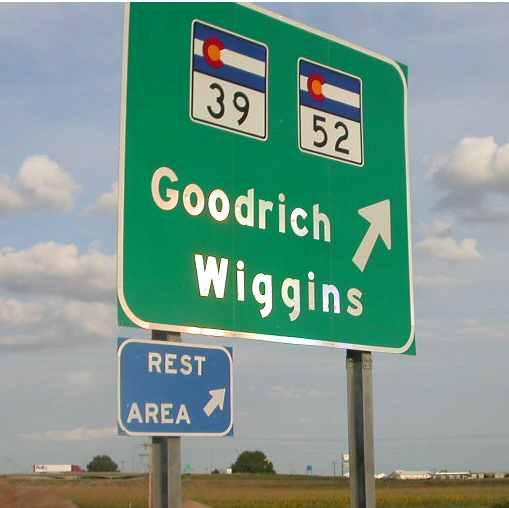
My buddy John Liskey was on a road trip to Mt. Rushmore when he discovered proof, he told me, that I'm a good person. He was kind enough to return with photographic evidence, shot professionally at 70 miles per hour by John's daughter, Corey Ann Liskey:


Hmm... Goodrich Wiggins. How Dickensian.

Saturday, August 13, 2005

Can you trust the digital odometer reading on that used car?

One estimate claims that 3/4 of all vehicle sales in the U.S. involve used cars or trucks -- a total of 45 million sales a year. What if millions of buyers are being defrauded by false odometer readings?

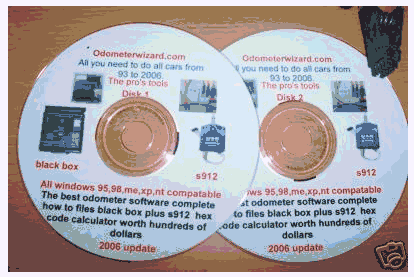
Someone is selling a kit that allows any backyard mechanic to reset digital odometers:

Click to see full-size screen shots.


Read the label on the CD, and you see a link to www.odometerwizard.com where you can buy this kit from the "retailer." At their Web site you'll find this inspiring disclaimer:


Yeah, right. We're selling this kit that will let anyone who's handy under the hood reset a digital odometer. Please do not use this to defraud anyone.

This was first reported on Dave Farber's mailing list by EEkid@aol.com, who was looking to buy a used truck, but found it odd to see listings of trucks that were years old with only 5000 miles on them. The odometer resetter was for sale on Ebay.

This raises some interesting questions:
  • How widespread is this fraud? This could represent hundreds of millions, or billions, of dollars in annual fraud.
  • How will Ebay respond? The device isn't inherently evil, but you've gotta believe most buyers are not working in pristine mainstream repair shops.
  • What is the auto industry's stance on this? Is there a technical solution that would at least inform buyers of used vehicles that the odometer is no longer in virgin factory status?
  • When will the media pick this story up? (Farber's list is the source of many an article you read in The New York Times.)
  • Will Congress respond?
  • What will Elliot Spitzer (New York Attorney General, the Elliot Ness of our time) do?

And also: who the heck is EEkid@aol.com?

Wednesday, August 10, 2005

The Tilt-a-Whirl, Visualized

My wife insisted on going to the county fair and riding the Tilt-a-Whirl. That is the last thing I ever want to experience. But she insisted, and so I went along.

I tried to photograph the experience with my new Canon Rebel XT DSLR. This shot came out rather surrealistic:


Click on the image to see it full-size. Honest to God, that is not a computer generated image; it's a photo taken at dusk at a county fair as the world whirls around.