
Wednesday, January 16, 2013
Tuesday, January 15, 2013
Facebook charges you $100 to post to people they term important

This has interesting implications for journalism. In a world when Thomas Friedman gets speaking gigs for $50,000 a day, now a news source has to pay the reporter $100 just to submit a tip.


Friday, January 11, 2013

Tuesday, January 08, 2013
The Tide has turned, the game is won, yet a ticket seller is advertising Notre Dame as victor

Just now advertised on Facebook. I write this at 6:27 AM on January 8, 2013. TicketsNow is bragging that Notre Dame will win the national championship in NCAA football. The only problem is, Alabama won the game last night.
Things I wonder:
- How much is TicketsNow paying to advertise a game that has already been played?
- Why would a ticket vendor pick a team as a favorite? Isn't their goal to sell tickets, not pick winners?
- Having spent money advertising tickets for a game that has already been played, and cheering for a team that lost decidedly, what will the marketing manager for TicketsNow choose as his next line of work?
- Why would a ticket vendor pick a team as a favorite? Isn't their goal to sell tickets, not pick winners?
- Having spent money advertising tickets for a game that has already been played, and cheering for a team that lost decidedly, what will the marketing manager for TicketsNow choose as his next line of work?
Friday, January 04, 2013

Wednesday, November 28, 2012

Monday, August 06, 2012
Facebook continues to threaten me with censorship
So I enter into the discussion about Harry Reid and Romney's taxes. To the uninformed eye, my position is a tad complicated: I think Romney should make public his taxes, as his dad, George Romney, did in the 1960s.
I also think Harry Reid is acting like McCartney in saying he "heard someone say that maybe Romney didn't pay taxes the last many years."
So I try to post this view on Facebook, and once again, their robot accuses me of spam.
Facebook has a bot that confuses discourse with discussion.
I also think Harry Reid is acting like McCartney in saying he "heard someone say that maybe Romney didn't pay taxes the last many years."
So I try to post this view on Facebook, and once again, their robot accuses me of spam.
Facebook has a bot that confuses discourse with discussion.
Monday, March 05, 2012
CBS News claims Hedy Lamarr invented Wi-Fi
CBS News reports about a book about the 40s actress Hedy Lamarr under a headline claiming that she invented Wi-Fi. (They misspelled the term as "WiFi", by the way.)
There is credible evidence that Lamarr came up with the notion of frequency hopping. Clever idea that has nothing to do with Wi-Fi. In fact, the original incarnation of Wi-Fi shared spectrum with microwave ovens and home cordless phones. My wife could jam my Wi-Fi connection by warming coffee or making a phone call. IEEE 802.11b was very susceptible to interference.
Claiming Hedy Lamarr invented Wi-Fi is a nice glamorization. She conceived frequency hopping, for which she deserves due credit. She did not invent Wi-Fi. Even Isaac Newton said he stood on the shoulders of giants.

There is credible evidence that Lamarr came up with the notion of frequency hopping. Clever idea that has nothing to do with Wi-Fi. In fact, the original incarnation of Wi-Fi shared spectrum with microwave ovens and home cordless phones. My wife could jam my Wi-Fi connection by warming coffee or making a phone call. IEEE 802.11b was very susceptible to interference.
Claiming Hedy Lamarr invented Wi-Fi is a nice glamorization. She conceived frequency hopping, for which she deserves due credit. She did not invent Wi-Fi. Even Isaac Newton said he stood on the shoulders of giants.

Tuesday, February 28, 2012
Nice surprise birthday card
A Facebook friend was kind enough to take a Wall photo of mine and turn it into a birthday card. I thought that was a nice thing to do.


Saturday, February 25, 2012
QR codes are for physical objects...
Not Web pages. It adds no value to slap a QR code on a Web page or resource that could be a hyperlink.


A QR code is, at root, a 2 dimensional bar code. It can be useful if someone is in sight of a physical object where it is more efficient to scan some quick info in, assuming your consumer of info has a QR decoder handy on a smartphone with camera.
But people are using QR codes as if they are the latest thing in social media. It is an updated bar code from the 1990s. It is intended to be something you use a handheld device to read when processing, say, the handling of a piece of equipment moving on an assembly line. If you think you are a way cool 21st century Web consultant and are encouraging your customer to use QR codes, welcome to 1994 and the label on your delivery package.
Hint: Don't publish a QR code if your reader is online and could just click on a hyperlink.
Hint number 2: Don't forget the power of a simple URL.
But people are using QR codes as if they are the latest thing in social media. It is an updated bar code from the 1990s. It is intended to be something you use a handheld device to read when processing, say, the handling of a piece of equipment moving on an assembly line. If you think you are a way cool 21st century Web consultant and are encouraging your customer to use QR codes, welcome to 1994 and the label on your delivery package.
Hint: Don't publish a QR code if your reader is online and could just click on a hyperlink.
Hint number 2: Don't forget the power of a simple URL.
Friday, February 17, 2012
WZZM Grand Rapids presents questionable spelling feature
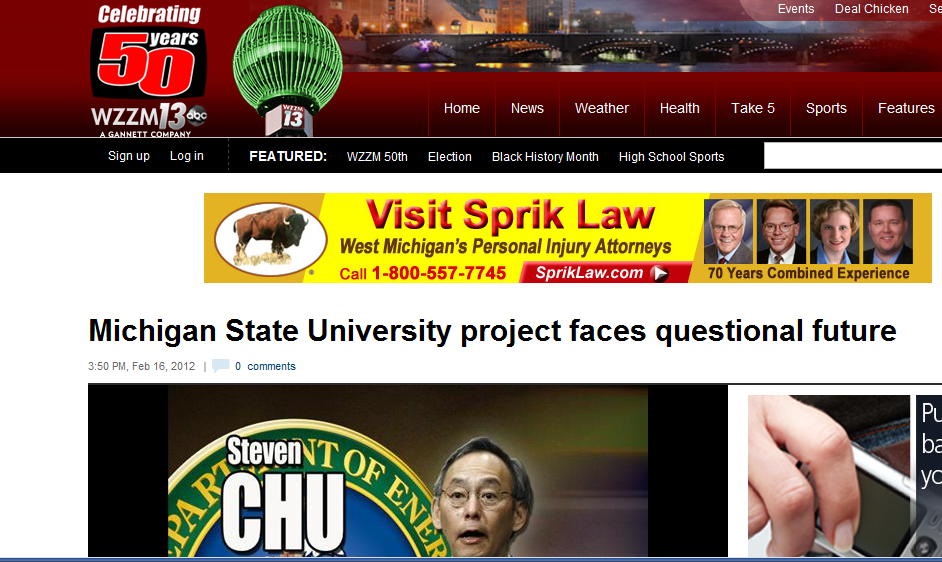
Questional??? Well you are a Gannett media outlet.
Sunday, October 02, 2011
Michigan State event: "Relics of the Big Bank"
I saw this event title on the MSU events calendar:
"Relics of the Big Bank"
Hmm, sounds like it might be interesting, in light of the recent banking and financial crisis. Maybe it also covers historical context, such as previous bank failures, in the Great Depression and in previous financial panics.
Actually it's about the Big Bang, not the Big Bank. It's MSU's Physics-Astronomy department, an event at the MSU Planetarium.
A big university covers many areas of inquiry...

"Relics of the Big Bank"
Hmm, sounds like it might be interesting, in light of the recent banking and financial crisis. Maybe it also covers historical context, such as previous bank failures, in the Great Depression and in previous financial panics.
Actually it's about the Big Bang, not the Big Bank. It's MSU's Physics-Astronomy department, an event at the MSU Planetarium.
A big university covers many areas of inquiry...

Subscribe to:
Posts (Atom)