Sunday, May 09, 2004

Gmail really wants you to not delete your old mail

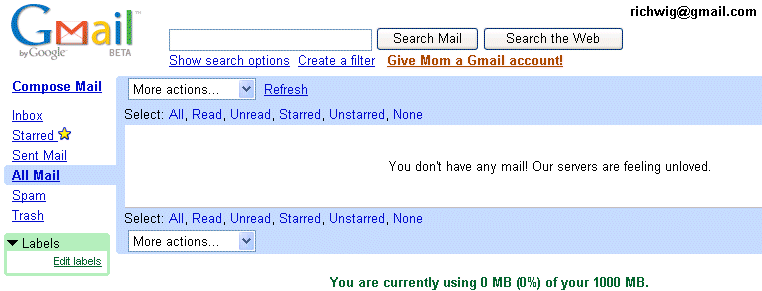
Check out the message Gmail emits when you empty your mailbox.


Without becoming a conspiracy nut, I think Gmail goes out of its way to encourage you to leave old messages in your All Mail folder. My guess is they continue to data mine the messages long after you've forgotten them.

Sunday, April 11, 2004

Gmail Quotes: Lost in Translation

Curious to see how the press around the world is covering the Google Gmail story, I used - of course! - Google to search. I found what appeared to be part of Katie Hafner's article in a Brazilian newspaper. So I used - of course! - Google to translate it from Portuguese to English.

The results were hilarious. Automated translators often emit some pretty goofy stuff, but a couple of these were real gems:

"If the Google supplies to the user a system anti-virus and anti-Spam and a great storage and the power of its tool of search, where I can find e-mails old, I change myself", I said Richard Wiggins, technologist of the information of the State University of Michigan in East Lansing, Michigan. "Those boxes of email with 50 megas do not serve more for nothing".
....
"For the majority of the people, I find that he will not be terrible to read an email on Key West and an announcement to appear in the page. I do not see problem in this ", I affirmed Wiggins. "But and if I receive sympathies from a friend for the death of a together relative with an announcement of a funerary house".


Wiggins agrees. "This box of email now competes with the servers of InterNet, CDs and DVDs you rewrote and iPods to carry, to load and to share personal content", affirmed.

I assume that Ultimo Segundo used a human to translate from English to Portuguese; if not, things are doubly lost in translation.

http://ultimosegundo.ig.com.br/useg/nytimes/artigo/0,,1573954,00.html

Thursday, April 08, 2004

New York Times Quotes on Google and Gmail

Katie Hafner quoted me in today's New York Times on the subject of Google and Gmail. See
http://nytimes.com/2004/04/08/technology/circuits/08goog.html.

I liked her article, especially her line about "privacy is the currency of the Internet."

One quote I'd like to see publicized: Gmail will cause the largest migration of private information in world history as millions of people move their mail from Webmail providers and local hard drives to Google's Gmail 1 gigabyte mailbox servers.

Saturday, April 03, 2004

Audio link: Radio interview about Google

Yesterday the Michigan State University NPR station, WKAR, broadcast an interview between Scott Pohl and me about Google. (The Gmail story broke after we recorded the interview.)

Here's the promo:

Experts who keep an eye on the internet expect the search engine called \"Google\" to go public soon and speculation is rampant about what the company will do with the billions of dollars the initial public offering is likely to generate. Scott Pohl asked author and MSU technologist Rich Wiggins this week why so many people like and use Google. | aired Apr. 2, 2004

Here's the interview:

Radio interview with Scott Pohl about Google -- the IPO, its dominance, and more

Thursday, April 01, 2004

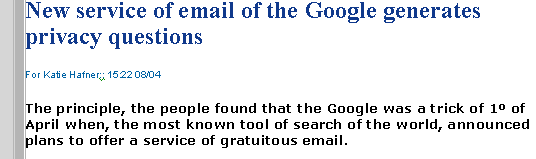
Google launches e-mail service with 1 gigabyte of free storage

The press is abuzz: Google plans to offer an e-mail service to blow away Yahoo mail and Hotmail, featuring 1 gigabyte of searchable storage -- 100 times what the others give for free. The idea is to let you Google your inbox instead of having to file messages into topical folders. If this is for real, it could cause the largest migration of personal information in history.

The idea of indexing your personal messages instead of manually filing into categories is exactly analogous to Googling the Web instead of Yahooing it; it makes perfect sense. I first observed someone doing this circa 1993: Hal Varian, now dean of SIMS at Berkeley, then of U Michigan, showed me how he used WAIS on his Next workstation to index all of his e-mail.

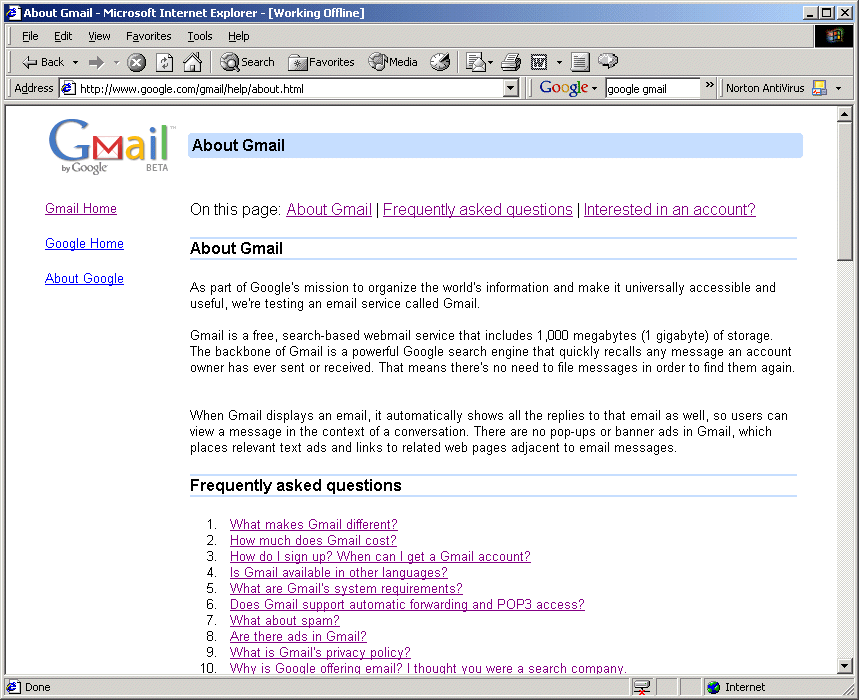
So it's a fantastic idea. Maybe too fantastic: the press release has a couple of fishy quotes; you can't sign up for the service, only register for more info; and today is... April 1. The purported site, gmail.google.com, appeared and then vanished, but not before I got a screen cap. (As of later in the morning, the Gmail site came back up. But it still only lets you sign up to receive future information.)

My first bet was it's an April Fool joke, and a funny way to take shots across Yahoo and Microsoft's respective bows at the height of IPO fever. Folks on the Web4lib mailing list take it to be real. Virtually all of the major media picked up the story. The coverage in The Guardian noted the whimsical aspects of the press release and the April 1 timing.

If Google really does offer this service, this story has effects far greater than poaching market share from Hotmail and Yahoo mail. It's a huge blow to ISPs and Webmail providers. It will lead to a massive shift of e-mail content from from service providers around the world to Google's servers. This could be devastating to companies such as usa.net, which charge an annual fee of $40 or more to give you a 50 megabyte mailbox -- 1/20th of what Google claims it will offer for free.

Many people manage their lives in e-mail. They refer back to messages from the boss or the prof or the spouse. They send to-do messages to themselves. A 1 gigabyte searchable mailbox would be tremendously more useful than the 10 to 50 megs other providers offer. (Universities that offer paltry 50M mail accounts will see thousands of students set forwarding to their Gmail accounts. University IT administrators everywhere must be lowering their budget estimates for new storage -- and wondering how relevant their Webmail service now is.)

If also means a huge data mine for Google to exploit to offer to advertisers. The Gmail terms of service state explicitly that Google will analyze the content of your messages in order to target advertising. See: the Gmail privacy policy.

When Google raises $20 billion in its IPO, it'll have plenty of cash to pay for the service. Other Webmail providers won't be able to compete; their targeted ad programs won't have Google technology and Google ad performance.
Sunday, March 28, 2004

Conference Facility Breaks Internet Speed Records

The Henry Center at Michigan State University touts itself as a unique conference and training facility. Outside each room they post a description of the technology inside. Look closely to see how fast they deliver Internet to each seat:


Tuesday, March 16, 2004

A Very Brave - Or Very Foolish - Michigan Fan in Ohio

ESPN has a TV ad showing a young couple making out on a couch, one wearing a Michigan shirt, the other Ohio State. Today on a trip to Columbus I spied a personalized license plate on a car whose owner must be very brave -- or who possesses excellent auto insurance:


Saturday, March 06, 2004

Unnoticed Irony: Imclone Stock Always Beat Martha Stewart Omnimedia

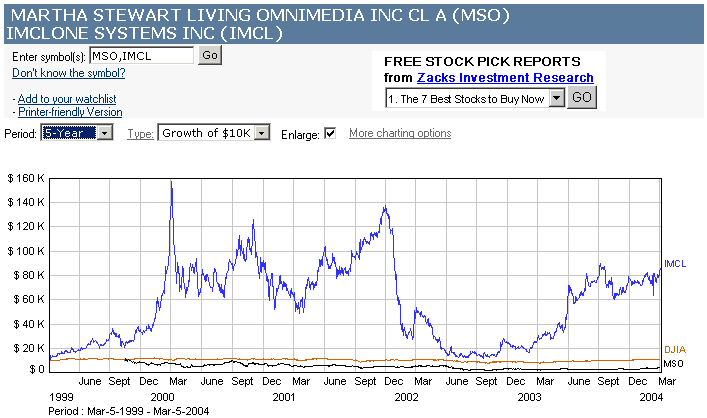
If you'd invested $10,000 in Martha Stewart Omnimedia and $10,000 in Imclone on the day when MSO was born, which investment would have brought you better results? Was an MSO investment ever a better bet versus Imclone?

Many note the irony that Martha Stewart had only $52,000 at stake in her Imclone investment, yet her insider trading scandal destroyed billions of dollars in shareholder value in her own company. Yesterday alone, after the verdict, the value of Martha's shares in Martha Stewart Omnimedia fell $100 million. People are delighting -- or fretting -- over her potential time in prison. Martha may be more worried about the likely loss of her personal fortune than her prison term. Her company's products are based on the very image of Martha; can it reinvent itself sans eponymous founder?


And in the "truth is stranger than fiction" category, the FDA approved the drug Erbitux for treatment of certain cancers on February 12, 2004 -- during Martha's trial. That's the very drug that the FDA disapproved in December 2001, leading to the insider trading. The made-for-television movie will have fun with that.

Another layer of irony: Imclone stock plummeted when the scandal broke, but has done quite well since then. I ran a Quicken.com stock chart comparing what you'd have today if you'd invested $10,000 in each company five years ago -- an interval covering the entire lifespan of Martha Stewart Omnimedia. Eyeballing it, it looks like if you'd placed a $10,000 bet on Imclone the day of the MSO IPO, you'd have $40K today. It looks like MSO stock never rose enough for you to cash out ahead. In fact, MSO was never ahead of the Dow Jones average.

Just wait until Monday, when reality sets in: MSO is so closely identified with Martha Stewart, this company is doomed.


Thursday, March 04, 2004

Google versus Librarians -- and Google has won

A recent piece by Washington Post author Joel Achenbach quotes Berkeley's Peter Lyman:

"There's been a culture war between librarians and computer scientists," Lyman says.

And the war is over, he adds.

"Google won."

Of course librarians struggle to explain to students and others that Google alone doesn't suffice in many cases, but I didn't think there was a war going on. In fact, a librarian, Cindy Chick, introduced me to Google soon after Page and Brin launched it at Stanford. It seems to me that as a cohort librarians probably rely on Google as much as anyone else -- they just know how to use it better, and they don't use it exclusively.

For almost a year I've been saying openly that "Google has won," but the war I have in mind is Google versus Yahoo, AskJeeves, AlltheWeb, etc. Not everyone agrees. Last June, I postulated that Google had won to Craig Silverstein, Director of Technology at Google and he quickly distanced himself from the notion. Google principals display a quiet confidence but also studied humility. When I gave a talk at Internet Librarian entitled "Why Google Won", some folks from Yahoo wanted to have a chat with me afterwards -- in the Monterey Bay.

What's surprising to me is which "side" Peter takes in Google vs. Librarians :

And yet Berkeley professor Peter Lyman points out that traditional sources of information, such as textbooks, are heavily filtered by committees and are full of "compromised information."

And the open public Web is full of authentic, up-to-date, accurate information, that Google always puts at the top of the hit list? Peter, come back to visit for some Lake Michigan whale watching!!!

Actually, I bet this will prove to be a false dichotomy, as Google integrates more and more commercial content under their search umbrella, such as their recent IEEE partnership. We may yet see an Advanced Search radio button toggling between the Public Web versus Commercial Content Filtered by Committees, Full of Compromised Information. Important treaties are yet to be signed in Mountain View.

Wednesday, March 03, 2004

The Quixotic Quest for Universal Broadband

Tonight I'm privileged to give a talk at the Ann Arbor Computer Society. I first spoke there in spring of 1993, when the subject was this newfangled thing called "the World-Wide Web." (Back then, it was hyphenated, kind of like Berners-Lee.)

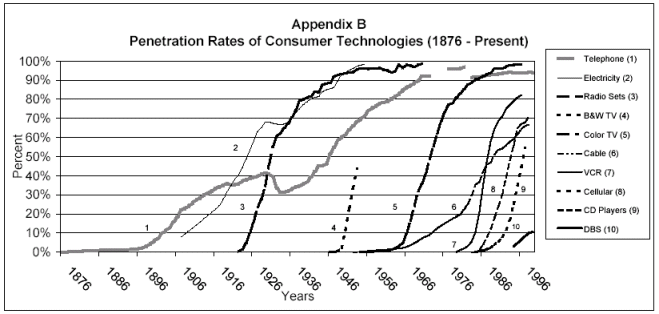
For quite a while I've wanted to find or create a graph that shows how many years it takes for a technology -- telephone, electricity, indoor plumbing, CD players, dial-up Internet access, residential broadband -- to achieve 90% or 98% penetration.

It turns out the FCC took a stab at creating such a graph:


The source for the graph is:

http://www.fcc.gov/Bureaus/Common_Carrier/Notices/2000/fc00057a.pdf

The FCC offers a collection of reports on Internet and telecom deployment at:

http://www.fcc.gov/wcb/iatd/comp.html