Sunday, October 17, 2004

Google searches your own computer: powerful, and perhaps scary

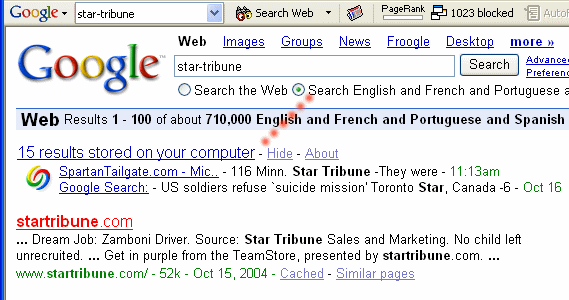
I've been playing with the new Google desktop search since it was announced last week. Already it's annoying me a bit. For instance, Michigan State clobbered Minnesota in football so thoroughly yesterday that I wanted to see how the Minnesota press was reacting. So I Googled to find the main Minneapolis newspaper, the Star-Tribune. The hit list surprised me:


Whoa! Wait a minute! Why do I see anything on my own computer about the Star-Tribune? I haven't said anything about the Star Tribune, or even read anything they published, for months.

The idea of Google Desktop is simple and powerful -- and not new, AltaVista released a desktop search years ago. One of the great ironies of the Google era is it's easier to find a document on the Web than on your own hard drive, given the poor tools Windows has built in. But when I search the Web for "star-tribune" (a newspaper I rarely read) coughing up hit list results cached from previous Google News searches (links I never followed) is just plain noise.

I'm not sure I want to search my own Web history on my own hard drive every time I search the Web. When you use Google to search the Web, what appears on the top of the hit list is largely determined by how popular the page is. What's in your browser cache is too random to give Google Desktop many hints as to what to put first -- or whether to show it to you at all.

Tuesday, October 12, 2004

Gmail gains a timeout?

Tilting at windmills for months, I've tried to get the media to pick up on the inexcusable failure of Gmail to have a simple timeout: don't use the Webmail client for an hour or so, and you have to log back in. This is a basic and vital protection for security and privacy; they should've designed the feature into Gmail from day one. Privacy zealots and the media missed this one big time.

Twice today I've been suddenly signed out of Gmail, zapped back to a login screen. Hmmmmm, have they implemented a timeout -- finally?

Friday, October 08, 2004

Once again, CBS News doesn't know when a document was first produced

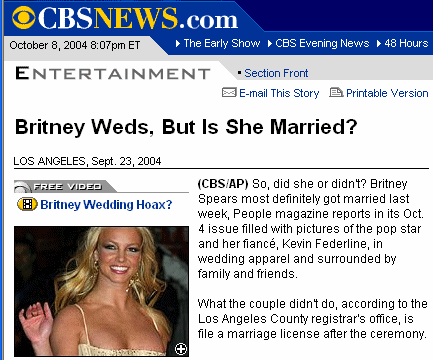
The major media is now reporting that Britney Spears finally filed her marriage certificate, so she's legally and officially married. (I know, I know, who cares about that story?) But Google News reports conflicting renditions:


Huh? The CBS story asks the question, and the News.com.au story answers it. What's going on here? Here's the CBS lead:


Huh? CBS offers a date of October 8 above this leading news item, but the piece itself is dated September 23. (Adding confusion, CBS cites an October 4 issue of People; no doubt the issue came out September 23.) The Google News clustering tool doesn't know it's an old article, and, whatever algorithm it uses to pick the lead version of the story puts CBS' out-of-date coverage ahead of the breaking news coverage by other outlets who have the current scoop.

Now here's the fun part: CBS itself has the updated story, later on the very same Web page!


Memo to CBS and Google: you can't always trust the timestamps that content management systems assign to documents.

http://www.cbsnews.com/stories/2004/10/08/entertainment/main648336.shtml

Thursday, October 07, 2004

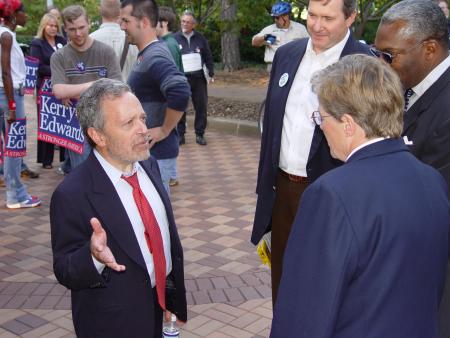
Former Secretary of Labor Robert Reich visits Michigan State

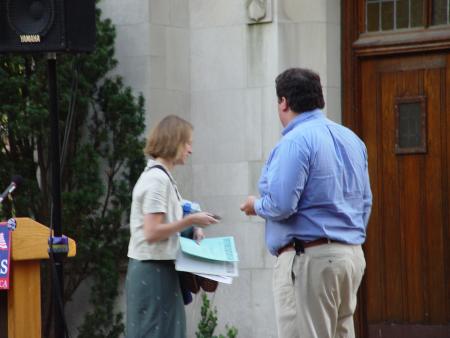
Today Robert Reich, the first Secretary of Labor in the Clinton Administration, spoke at Michigan State University. First he lectured at the College of Law, then spoke at a "rally" at Beaumont Tower. Unfortunately, the organizers of the second talk, MSU Democrats, did a poor job of rallying attendance; only a couple of dozen folks were at Beaumont Tower to meet this distinguished visitor.


I was the first to shake hands with Reich when he arrived. Reich puts people at their ease instantly. We chatted for a bit and then Lou Anna Simon, MSU's next president, dropped by to say hello to him. Her handler introduced her as "president designate" and Reich joked "Why would you want to be the president of a university?" I overheard their conversation as she invited him to return to East Lansing as part of MSU's esquicentennial. Reich said it'd be impossible not to return to such a beautiful campus. It was a beautiful fall day, but Dr. Simon replied she couldn't guarantee good weather in Michigan.


Dr. Reich spoke passionately to the small gathering: he said this year's election is the most important in living memory, and the George W. Bush is the worst president since Millard Fillmore -- and that that was unfair to Fillmore. I caught some of his words on video; the camera was my Sony DSC-F717, which is a great still camera, but a pretty weak video cam. His words come through, nonetheless; listen to some of Reich's remarks on the 2004 Presidential election.

One observation stood out:

The only thing constraining this Administration in the first four years -- the only thing limiting them at all -- has been the knowledge that they had to seek re-election. And if they get a second term, they are going to be unconstrained. And if you think things are bad now, you ain't seen nothin' yet.

Before Reich arrived, I called my friend Mark Grebner from the scene, describing how small the crowd was. Mark said that maybe I should enter a Wiki entry under "Bad Advance." The funniest part was when a carilloneur arrived to play her scheduled evening concert on the bells of Beaumont Tower. She was kind enough not to play the carillon while Reich spoke.


More of my photos of Reich's visit are available at:

http://www.imagestation.com/album/pictures.html?id=3195890093

Registration is required, but it's free. Hmmm, sort of like registering to vote.

Saturday, October 02, 2004

Librarian detects computer nerd, banishes to nearby cybercafe

Strolling around the picturesque and bucolic town of Harbor Springs, Michigan, I spy an interesting looking building.



It appears to be a familiar Northern Michigan tourist trap, a fudge shop. But I notice a side entrance with a different sign:



I like to check out small libraries (er, no pun intended). I'm curious: What kind of books and magazines do they carry? Do they they provide computers with Internet access? Do they offer Wi-Fi? So I climb the stairs and discover that the second floor of the building is a cute library. There's a desk across the room, with a thin older woman facing customers. She's chatting with someone who appears to be a friend of the library.

The older woman asks "Can I help you?" I reply, "No thanks, just looking." Her friend explains that this is not a public library; it's a private library that's open to the public. The staffer -- director? proprietor? -- explains that the library owns the building and therefore is supported by rent from the fudge shop.

I wander around a bit. Probably a few thousand volumes. Collection looks old. I don't see any magazines. Hmmm, looks like no computers at all, not even for a catalog. I head for the 20 drawer card catalog, and the woman fairly accuses me:

"You're looking for a computer, aren't you!?!"

"Well, yes, among other things."

Now she scolds me: "We don't have any computers. There's a cybercafe across the street." She turns to her friend and derisively proclaims "The ones that want computers never ask."

Back outside, I don't go to the cybercafe, but I do check out the building more carefully. A close look at the keystone reveals:



Hmmm, keystone indicates HSCA Library... 1908. Harbor Springs Community Association, perhaps? Now I'm curious how this private library that's open to the public came to be. Harbor Springs is a sleepy town in 2004; it must've been really sleepy in 1908.

Apropos of my treatment while inside, the only thing I can find on the Web about this library is its phone number and address. I can just hear the lady declare "We haven't needed a Web site since 1908. People know where we are. Go back to your cybercafe."
Thursday, September 30, 2004

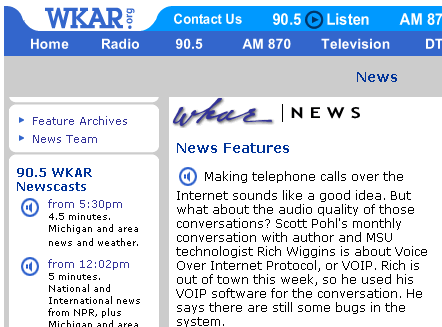
Skype: WKAR radio interview demonstrates quality of a VOIP call from Northern Michigan to East Lansing

Scott Pohl of WKAR-FM (NPR in East Lansing) and I discussed Skype, the VOIP (Voice over IP) startup from the folks who brought you Kazaa. Skype users can talk to each other for free over the Internet, or a Skype user can use Skypeout to dial out on the global switched telephone network to reach virtually any telephone on Earth. Skype-to-Skype is free; Skypeout is cheap -- for instance, 1.7 Euro cents a minute to call the U.S.


This was a fun interview, becuase our topic was VOIP long distance, and our means of communication was VOIP long distance.

The recorded interview gives you a pretty good idea of the quality of voice over IP a la Skypeout.

Now that AT&T is pronouncing the acronym as "voyp" in national ads, I guess that means it's now in the lexicon.


http://red-cedar.wkar.msu.edu:8080/ramgen/Archive/features/041001_richoct04.rm

Saturday, September 25, 2004

Register.com's anti Whois robot recognition device is now anti-human

Register.com has adopted a mechanism to prevent robots from harvesting Whois (domain name system) information. It requires you to type in a random string of text that's obscured so that software robots can't interpret it.


I defy anyone to read this obscured text.

Washington Post: great editorial on Cat Stevens episode

The Washington Post offers very sensible words on the lack of common sense in how Homeland Security handled the Cat Stevens incident:

Some of the intelligence reform legislation pending in Congress does call on the DHS to make the procedures surrounding the lists more transparent. But it is doubtful that any system that runs by automatic procedures, as this country's does, will ever be able to deal sensibly with individual cases. Whatever money the former Cat Stevens may or may not have given to terrorist organizations, was it really necessary to stop his plane in Maine? It's unlikely that he is so dangerous that his plane could not land at Dulles, and very likely that the grounding was ordered solely because security bureaucrats were following inflexible rules, without thinking through the consequences. What was missing was common sense.

When I flew to Amsterdam and back in November 2001 -- just after 9/11, I saw how Europeans do passenger screening: with intelligence. The screener looks you in the eye and asks you questions as an experienced police interregator (or defense attorney) would do -- out of order in time sequence, trying to catch you in an inconsistency. Every time I've flown in the US since then, I sense rote following of rules, not an intelligent agent.

Thursday, September 23, 2004

Sometimes Gmail offers the strangest ads

Today I glanced at the Sponsored Links served up for a very short message I'd sent, and I was surprised to see that they all related to physics. Odd; my message had nothing to do with physics, and didn't have any terms related to physics.
I tried Googling the recipients' names, and discovered that apparently one of my correspondents shares a surname, Thorsen, with a number of prominent physicists. (Is there some Thorsen physics dynasty out there?)

It's hard to imagine how the name of a recipient is ever a good clue as to what products I might buy.

Related curiosity: I clicked on that New York Times ad, promoting the paper as a great resource for physics students and faculty at universities. But if you follow the link, you're just dumped on a page touting The Times generally. Clue: a pitch promising things to a specific audience needs to follow through with a targeted ad.

Time to tweak the algorithm, Googleguys...

Cat Stevens confuses Google News, too

Cat Stevens was denied entry into the United States because the government's "watch list" indicates he's given money to terrorist-connected organizations. While neither confirming nor denying that I listened to his music in the 70s, and while certainly not admitting that I attended a concert by Cat (at Cobo Hall, a most intimate venue for a folk/rock singer) ... I doubt he's the kind of person who'd knowingly fund terrorists.

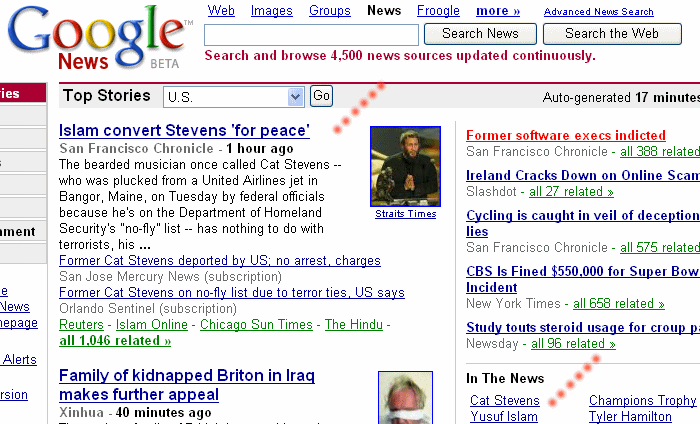
The global news media leapt on the story, and Google News didn't know what to make of it. Its algorithm chose Cat's rebuff as the lead story this morning -- more important than bombings and beheadings.


Google News was also confused by the fact that most reports listed the former pop star as both Cat Stevens and the Muslim name he adopted, Yusuf Islam. Google's "In the News" segment, which tries to call out the names of people in the news, lists both names -- and offers a different hit list depending on which one you pick.

Sunday, September 05, 2004

Lou Rosenfeld weighs in on site search

Lou Rosenfeld has done some thinking about site search and what it should deliver. Useful thoughts. Capsule summary:


Locating search: Where is it?
Scoping search: What will be searched?
Query entry: How can I search it?
Retrieval results: What did I find?
Query refinement: How can I search some more?
Interaction with other IA components: Can I switch to browsing when search isn't doing the trick?
Finishing search: What can I do now that I've done searching?


http://louisrosenfeld.com/home/bloug_archive/000290.html

Great quote about English and other languages

From Bookcrossing site:

"English doesn't borrow from other languages. English follows other languages down dark alleys, knocks them over and goes through their pockets for loose grammar."