
Saturday, February 19, 2005


Katie Hafner drags up the Al Gore Internet canard
Katie Hafner literally wrote the book on the history of the Internet. I've admired her writing for years, especially her pieces in The New York Times. (She also wrote the article "For Some, the Blogging Never Stops" that featured Wigblog in The Times.) I was pleased to see her article in The Times about Vint Cerf and Bob Kahn getting the Turing award. Too much credit has gone to Marc Andreessen (TIME cover for writing a browser) and Tim Berners-Lee (knighthood for repurposing SGML). It's great to see that the folks who made the Internet as we know it get some more formal recognition. (See my interview with Vint Cerf in 1998.)
But this paragraph in Katie's article really disappointed me:
Nearly a billion people have come to rely on the Internet as they do on a light switch. Very few know how it works, to say nothing of how it got here. A 10-year-old might think Google, Microsoft or perhaps Al Gore invented the Internet.
Katie, Katie, Katie. You wrote the definitive history of the Internet. Why drag up the canard about Al Gore inventing the Internet, even in jest? Al Gore never said that he invented the Internet. I wrote the definitive article debunking that myth for First Monday. (See Al Gore and the Creation of the Internet.)
It's ludicrous to think that any 10 year old believes that Al Gore created the Internet. Gore made his oft-misquoted remark in an interview with Wolf Blitzer on March 9, 1999. It's 2005, Katie! A ten year old today was four years old in 1999, and, unless a really precocious politics wonk, not likely to be watching Blitzer's interview that carefully.
Since 1999, Gore's statement has only been quoted in ridicule; no 10 year old would miss the "humor." Cerf and Kahn have publicly testified: Al Gore was instrumental in getting funding for the NREN, which was the high-speed backbone in the 80s that allowed NCSA and others to demonstrate what the Net could do. Gore deserves credit for his prescience instead of Jay Leno monologue material in The New York Times.
No one person "invented the Internet" but on September 28, 2000 the two primary inventors of the Internet Protocol -- the very men Katie profiles in her otherwise laudable article, Cerf and Kahn -- released this statement praising Al Gore's role in Internet history:
Al Gore and the Internet
By Robert Kahn and Vinton Cerf
Al Gore was the first political leader to recognize the importance of the Internet and to promote and support its development.
No one person or even small group of persons exclusively "invented" the Internet. It is the result of many years of ongoing collaboration among people in government and the university community. But as the two people who designed the basic architecture and the core protocols that make the Internet work, we would like to acknowledge VP Gore's contributions as a Congressman, Senator and as Vice President. No other elected official, to our knowledge, has made a greater contribution over a longer period of time.
Last year the Vice President made a straightforward statement on his role. He said: "During my service in the United States Congress I took the initiative in creating the Internet." We don't think, as some people have argued, that Gore intended to claim he "invented" the Internet. Moreover, there is no question in our minds that while serving as Senator, Gore's initiatives had a significant and beneficial effect on the still-evolving Internet. The fact of the matter is that Gore was talking about and promoting the Internet long before most people were listening. We feel it is timely to offer our perspective.
....
The Vice President deserves credit for his early recognition of high speed computing and communication and for his long-term and consistent articulation of the potential value of the Internet to American citizens and industry and, indeed, to the rest of the world.
See http://www.interesting-people.org/archives/interesting-people/200009/msg00052.html
Monday, February 14, 2005

Friday, February 11, 2005
Google News Ranks Governor Granholm with Fiorina, the Pope, Blair, Ebbers, and the Prince of Wales
Google News tries to create a "People in the News" section as it scrapes content from thousands of news sources. Often it makes goofy mistakes. Its algorithm often falsely assumes that proper nouns are people. For instance, it might think that Ingham County is a rock star. I was surprised last night to see that the robot ranked Michigan's governor, Jennifer Granholm, with Carly Fiorina (deposed CEO of HP), the Pope, Tony Blair, the disgraced Worldcom CEO Bernard Ebbers, and the Prince of Wales:

Granholm gave Michigan's State of the State address this week, but that seems a curious thing to put her on the national stage. One scant day later, Google News has an entirely different cast on stage:

Hmmm, Guantanamo Bay, is that a new rap artist?
Granholm gave Michigan's State of the State address this week, but that seems a curious thing to put her on the national stage. One scant day later, Google News has an entirely different cast on stage:
Hmmm, Guantanamo Bay, is that a new rap artist?
Tuesday, February 08, 2005
Google Maps: when are these guys gonna slow down?!?
Just stumbled across Google Maps. Google hits another one out of the park... This takes the Web map experience to a whole new plane, with a level of interactivity and
ease of use that makes Mapquest seem so mid-90s.
http://www.google.com/help/maps/tour/
These guys are unbelievable!
I did find a funny glitch. They brag that you can quickly locate, say, a sushi restaurant. So I tried searching for "sushi East Lansing" and one of the listings was a little wacky:

It looks like they conflated items from the events calendar for Calvin College and turned a conservation club into a sushi joint!
ease of use that makes Mapquest seem so mid-90s.
http://www.google.com/help/maps/tour/
These guys are unbelievable!
I did find a funny glitch. They brag that you can quickly locate, say, a sushi restaurant. So I tried searching for "sushi East Lansing" and one of the listings was a little wacky:
It looks like they conflated items from the events calendar for Calvin College and turned a conservation club into a sushi joint!
Saturday, February 05, 2005
Yet another red state / blue state map
I ran across yet another red state / blue state map today:

At first I thought this was political parody -- they'd actually coded states based on which went for Bush versus for Kerry. But it turns out the map just depicts which states have stores in the Steve and Barry's discount university sportswear chain.
The map is an interactive Flash application, well executed by the way -- except there's no way to find out what blue versus red means other than by clicking.
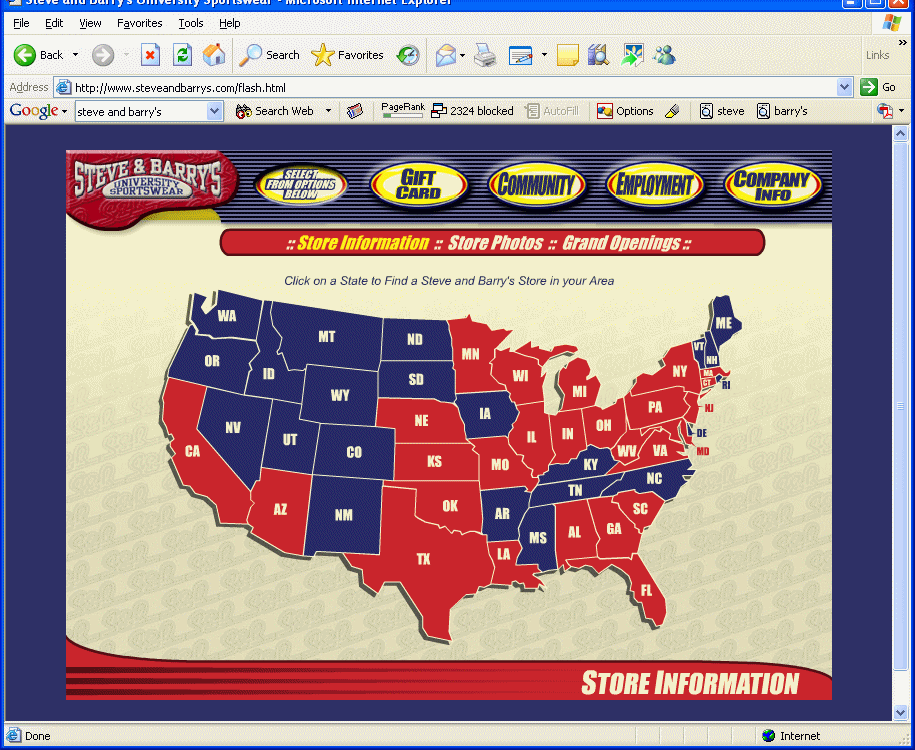
At first I thought this was political parody -- they'd actually coded states based on which went for Bush versus for Kerry. But it turns out the map just depicts which states have stores in the Steve and Barry's discount university sportswear chain.
The map is an interactive Flash application, well executed by the way -- except there's no way to find out what blue versus red means other than by clicking.
Thursday, February 03, 2005
How will Google prevent Gmail from being a storage depot?
Ever since the initial launch of Gmail, I've wondered how they'd prevent people from signing up for multiple accounts and using the service for high-speed, reliable, online storage, 1 gig at a time.
Need a place to put MP3 files? Big Powerpoint collections? Movies? Why not Gmail?
Lately I've been thinking that they might never open Gmail up for open enrollment; they might just stick to the invitation model. While that wouldn't solve the problem totally, at least it would limit it.

Just now I see that my stash of invitations has grown from the typical 6 to 50. Is this the real launch of Gmail? How many Gmail invitations do you see right now?
It would be fascinating to graph the pattern of Gmail invitations worldwide. I bet Google has the data from day one: who invited whom? Perhaps more importantly to Google: what mail service did they use previously? Hotmail, Yahoo, AOL...
Need a place to put MP3 files? Big Powerpoint collections? Movies? Why not Gmail?
Lately I've been thinking that they might never open Gmail up for open enrollment; they might just stick to the invitation model. While that wouldn't solve the problem totally, at least it would limit it.
Just now I see that my stash of invitations has grown from the typical 6 to 50. Is this the real launch of Gmail? How many Gmail invitations do you see right now?
It would be fascinating to graph the pattern of Gmail invitations worldwide. I bet Google has the data from day one: who invited whom? Perhaps more importantly to Google: what mail service did they use previously? Hotmail, Yahoo, AOL...
Monday, January 31, 2005
Google Video launches: misnamed and not up to par
Information Today published my Newsbreak on Google Video today. The product is unusual for a Google announcement: it's immature, and it's misnamed.
See the article at:
http://www.infotoday.com/newsbreaks/nb050131-1.shtml
Excerpts:
It’s surprising to test a product named “Video” only to find that there’s no video to consume. It seems that every page of hits yields the statement “Video is currently not available.” In response to the question “Can I play the videos that Google Video finds?” the Google Video FAQ states, “Not yet, but stay tuned ...”
....
One could even argue that Google has misnamed its new product. Google Video offers a way to search television content, and it offers a way to search local TV listings. But there is a lot more to video than television; one wonders why they didn’t name the product Google TV. Yahoo!, for its part, launched its own video product last week—a tool to search the Web for actual, playable video clips. Perhaps Google was influenced by its rival’s impending announcement. Or perhaps Google plans to expand beyond television, given that Google Images searches freely available images on the Web.
Tuesday, January 18, 2005
Boogie Bob, my doppleganger?!?

Recently while at Panera's (place that sells bread, soup, and sandwiches and offers free Wi-Fi) I encountered this fellow. Note the Sony Picturebook laptop. Looking closely, you can see the antenna of a Sierra Wireless card -- in other words he's got the exact same highly-portable Internet setup I had for almost two years.
It turns out this fella is none other than "Boogie Bob" Baldori. He has a colorful history: his band, the Woolies, had a pop hit called "Who Do You Love?" in the sixties. Now he's a rocker and a lawyer. See: boog.com
Sunday, January 16, 2005
Delicious mockery of Ipod Shuffle, Mac Mini, Steve Jobs, and Apple
Ouch!
Seth Jayson of Motley Fool offers some wonderfully wicked words about Apple's fortunes:
Living Up to the iHype
Don't let the headlines fool you (little f). It's about more than the iPod. But the amazing increases in profitability at Apple have one Fool wondering if he's not the one putting on the leather jacket and grabbing for the waterski rope.
The reference is to the time that Fonzi famously waterskied and jumped over a shark - a sign that a TV show has lost its compass.
In any event it's fun to see a detractor when the rest of the trade press thinks Apple is flying higher than ever.
Wednesday, January 12, 2005
Headless Mac a "cube-shaped computer"?!
Tech columnist Hiawatha Bray writes in today's Boston Globe:
Main Entry: cube
Pronunciation: kyüb
Function: noun
Etymology: Latin cubus, from Greek kybos die, cube
1 a : the regular solid of six equal square sides -- see VOLUME table
This tiny new Mac is in no way a "cube" -- its size and shape more resemble a paperback book:

As it happens Steve Jobs famously was associated with a cube-shaped computer, the Next workstation, introduced circa 1990:

It was cool to break out of the tower paradigm in the early 90s and have a cube-shaped computer on your desk. But memo to Hiawatha: the Mac Mini is shaped not like a cube; it's shaped like an Ipod.
In San Francisco, at the annual Macworld trade show, Jobs showed off the Mac Mini, a cube-shaped computer priced at $499, and a new $99 version of the red-hot iPod portable music player.Either Hiawatha didn't physically attend the keynote at Macworld where Steve Jobs introduced the device, or he's forgotten his basic geometry. Quoth Merriam-Webster:
Main Entry: cube
Pronunciation: kyüb
Function: noun
Etymology: Latin cubus, from Greek kybos die, cube
1 a : the regular solid of six equal square sides -- see VOLUME table
This tiny new Mac is in no way a "cube" -- its size and shape more resemble a paperback book:
As it happens Steve Jobs famously was associated with a cube-shaped computer, the Next workstation, introduced circa 1990:
It was cool to break out of the tower paradigm in the early 90s and have a cube-shaped computer on your desk. But memo to Hiawatha: the Mac Mini is shaped not like a cube; it's shaped like an Ipod.
Subscribe to:
Posts (Atom)