Tuesday, August 09, 2005

Canon "support" dies at the border

I had to replace my new Canon Digital Rebel XT -- which I thought I had fallen in love with -- because one feature failed to work: the camera has a most-welcome feature that automatically rotates photos you've taken to proper vertical orientation. The camera has a built-in sensor that detects its orientation, and it accommodates accordingly.

But with my new camera, the feature, while working fine for vertical images, also erroneously auto-rotated horizontal shots. So I went to Best Buy, where I bought it. I demonstrated to a helpful sales clerk on their floor model how it was supposed to work, and I demonstrated how my model worked. She worked with the returns department to swap out my camera. Kudos to Best Buy: the return process was pain free.


Now here's the problem: the new camera won't talk to the Canon software I already installed on my PC. Plug in the USB cable, turn on the camera, and a window pops up to select a way to view the camera's Compact Flash card. But click on any of a few software choices, and the computer says there is no data on the card -- which is not true.

At one point, having installed all the Canon software in English, I was amazed, and amused -- and frustrated -- to get a dialog box in Spanish.

So I went to the Canon site seeking advice or driver support. There I found a broken link to support for this camera.

I predict days of pain talking to tech support.

It is amazing how often a company, or a person, fails to live up to the standards one might reasonably expect.

Monday, August 08, 2005

If this is possible why can't we achieve world peace?


Picture taken in a hurry with a Treo 600 - click to see full size, and you'll note a DHL delivery person chatting amiably with one from UPS.

Sunday, August 07, 2005

Testing out the Canon Digital Rebel XT

Got my first digital SLR, the new Canon Digital Rebel XT. I read all of the reviews I could find, and other than those who decried the very idea of a plastic body for a DSLR, people who've tried the XT say glowing things. So far my experience is positive:

  • It's very compact, almost as small as my late, lamented Sony DSC-F717.
  • It's very fast in startup time. The autofocus locks quickly and usually can't be fooled.
  • It can shoot up to 14 shots in burst mode.

I'm still exploring its many features and have found a few quirks. All in all though I think I'm in love. I did a lot of shooting with film SLRs in the 70s and early 80s, and it's nice to be back in the realm of a viewfinder that's bright and accurate, and to have precise depth of field preview.

My first couple hundred test photos are at:

http://www.imagestation.com/album/index.html?id=2122687052

You have to sign up for Imagestation, but it's free.

One issue this camera presents is size of each image file: the Rebel XT is an 8 megapixel camera, which means some complex image JPEGs are over Imagestation's limit of 5 megs per image. When Sony releases an 8 megapixel camera, will they up the ante?

Friday, August 05, 2005

The long tail and the short head of the Zipf Curve

Chris Anderson of Wired is getting a lot of play since the publication of his October 2004 article on "The Long Tail." He makes some interesting observations about how especially when it comes to selling digital content, niche players can make a lot of money selling many items in low volume.

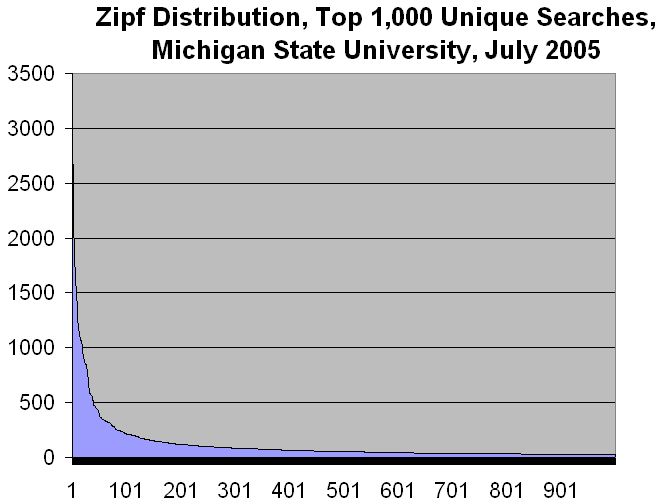
So we're seeing lots of examples of Zipf Curves, which I first came to understand 4 or 5 years ago when doing Web search log analysis. But you've got to define your terms and understand just how long that long tail can be. Consider two graphs:


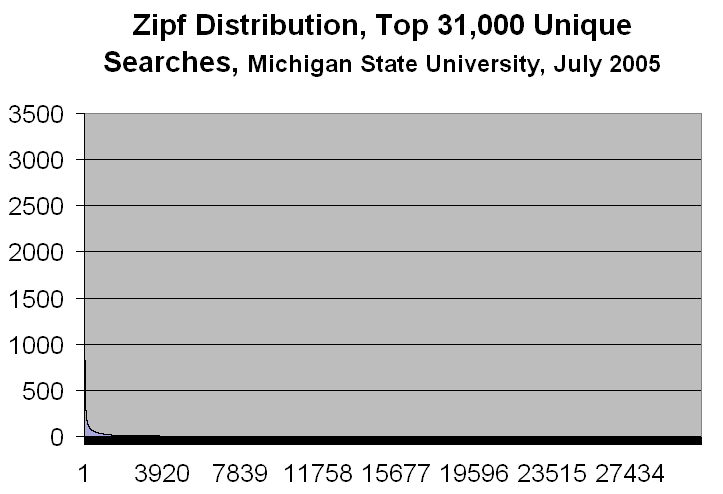
Now look at this one:
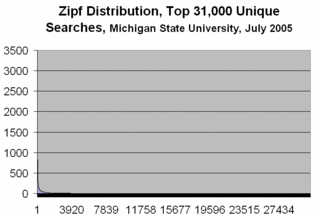

(Click to see full-size image.)

Here's the important part: These two charts represent the same data. The first one covers the top 1000 unique searches. The second one covers the top 31,000 unique searches. When you look at all searches in a given period, you discover a large number of unique -- one-off -- search phrases.

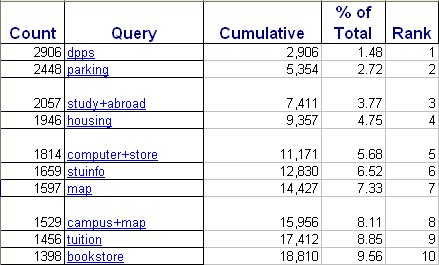
Another way of understanding the curve is to look at how many unique searches are required to reach certain percentiles of coverage. Look at the top 10 unique search phrases at Michigan State:
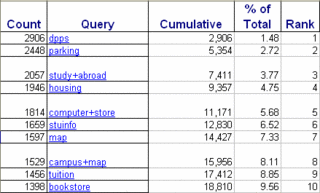
(Click to see chart full-size)

This dramatically demonstrates how much the "head" of the curve holds. Now, to understand the rest of the curve, we can examine how far down the curve we have to travel in order to achieve further coverage.

For instance, to cover 20% of all unique searches, we need merely include the top 32 items. To cover the rest of the curve:

Percent Rank
30% 85
40 203
50 441
60 925
70 2182
80 5617
90 13770
100 31000

Suppose, for instance, that we put some effort into providing "Best Bets" for our search engine, ensuring that we direct people to the "best" page for the most popular searches. Based on this sample, we could achieve that for 60% of all searches with a database of only 925 entries.

"The Long Tail" argument goes like this: there's lot to mine in the niches. But for search log analysis and Best Bets, you're a fool if you dedicate resources too far into the tail. You're turning yourself into a research librarian with thousands of customers daily. You can't afford to build a Best Bet for a search that may never be performed again.

I think there's a paradox here. Anderson gives the example of Netflix, which ships DVDs by US Mail. They can afford to keep much deeper inventory than, say, your local Blockbuster. So if you want to rent an obscure documentary, Netflix can make money and you get to see the obscure title you crave.

Anderson argues that retailers who distribute digital content, such as MP3 audio, can really win. Disk is cheap and distribution is practically free.

So here's the paradox: I think the equation is reversed for Web search services. Google is the leading search engine because the PageRank algorithm serves the short head of the curve, and the middle of the curve, so very well. Millions of people find what they seek. But travel too far out on the tail end, and Google will fail you. In fact, if there's only one or two links to your obscure page, Google may drop it right out of the index.

But sometimes you really need some obscure piece of information. You might have a question that you're willing to pay $1000 or $100,000 to have answered. Rather than paying less per unit in the long tail, you might be willing to pay many times more.

Even if you're not willing to pay big bucks, if your query is rare enough that you can't find satisfaction at the short head, if you're motivated enough to find your answer, you may spend real time and/or money to find your answer:


  • You ask your reference library to do some research.
  • You pay money to search a commercial database.
  • You hire an outsider to do the research -- perhaps a freestanding research firm, or perhaps you float your query to Google Answers.

So if your research query ends up being at the end of the long tail, you may pay more per item, not less.

Thursday, August 04, 2005

Google conducts worldwide search for chefs for its headquarters

Google actually sent out the following press release. Ya can't make this stuff up:

Google Hungry For Executive Chefs

MOUNTAIN VIEW, Calif. - August 4, 2005 - Google Inc. (NASDAQ: GOOG) today announced a worldwide search for two executive chefs with the experience to creatively manage the preparation of thousands of quality breakfast, lunch, and dinner meals each day at the company's Mountain View, Calif. headquarters. The executive chefs will oversee the development and continual refinement of an eclectic menu capable of suiting every Googler palate, from vegan entrees to pad thai, grilled burgers, and wood-fired pizza-all while using organic ingredients whenever possible.

"These two chefs will play an important role in managing the company's growing appetites," said Sergey Brin, president, Technology, Google Inc. "We welcome all culinary engineers to try out for our exceptional team."

The Cookoff
Qualified chefs are invited to submit their resumes to Google at jobs@google.com

. When a critical mass of submissions has been received, the top candidates will be invited to Google headquarters to prepare a meal for the "tasting committee." Four finalists will compete in a Google Chef Cookoff, whose two winners will be offered the roles of Executive Chef at Google.

Menu of Benefits

On-campus dining is an important item in the company's extensive menu of employee benefits, which also includes a staff MD, dry cleaningpickup and delivery, onsite car wash and oil change, gym, personaltrainers, tuition reimbursement, proximity parking for pregnant employees, nursing rooms for mothers, and more.

[Sample lunch menu available at http://googleblog.blogspot.com]

Interested applicants may review the position description at
http://www.google.com/jobs/facilities.html, and are encouraged to send a resume and cover letter to jobs@google.com.

About Google Inc.
Google's innovative search technologies connect millions of people around the world with information every day.

Founded in 1998 by Stanford Ph.D. students Larry Page and Sergey Brin, Google today is a top web property in all major global markets. Google's targeted advertising program provides businesses of all sizes with measurableresults, while enhancing the overall web experience for users. Google is headquartered in Silicon Valley with offices throughout the Americas, Europe, and Asia.

For more information, visit www.google.com.

# # #

Wednesday, August 03, 2005

Monday, August 01, 2005

McDonald's offers a tap instead of a swipe

Recently I noticed a new device on the counter at the local McDonald's near campus:


Look closely. This credit card terminal lets you swipe your card - as expected - and it lets you tap your card.


The oil company Mobil pioneered the concept years ago, with a small device you could easily put on your key ring. Hold your key ring with a smal special RFID device near the gas pump, and it authorizes a claim against your credit card. Now McDonald's and the credit card industry have caught up.

Fast food; fast payment. It's coming, and soon.

Saturday, July 30, 2005

Web brings amazingly useful info about digital camera choices

Back in the Seventies I was hooked on photography. My friend Mark Riordan and I had a secret darkroom in a closet in the Computer Center, set up with the assistance of our colleague Dean Franklin. Justin Kestenbaum, an MSU professor and one of the finest photographers I ever met, encouraged us.

Back then, I religiously read magazines such as Modern Photography and Popular Photography. It was sometimes suspicious how a favorable review of a camera or lens would appear next to an advertisement for same, but I read their words closely nonetheless. A couple of years ago when in the market for a digital camera, I stumbled on a Web site called Digital Photography Review. It blew me away. The site appeared to be a labor of love by a U.K. camera aficionado named Phil Askey.

Askey's reviews of digital cameras are in depth. A review in a magazine might be a few pages long. Askey isn't limited by the cost of print, so he reviews every aspect of a camera and its lenses in deep detail.

Askey is an example of a "subject matter expert" who's managed to parlay his expertise into a highly successful Web site. His site now features banner ads and ways to buy a camera after you read a review. He's affiliated with a number of retailers and I bet he is making money hand over fist through sales referrals.

I can't overstate how much deeper Askey's work is than what the magazines used to offer. And he's been doing this for years. Eventually his work will become an important history of digital photography technology. Of course, he's not alone; others try to emulate his success.

Another example of such an expert is John Beale, who covered in minute detail the features of a wonderful Sony camcorder, the TRV900. Before and after I bought that camcorder several years ago, I turned to Beale's Corner for his expertise and wisdom. Here's how he describes his site:

The Sony TRV900 is a high-end consumer MiniDV camera. Sold from 1998-2002, it has demonstrated a lasting value rare in electronics, remaining popular with both hobbyists and professionals, for its compact size and good performance. This page represents my collected knowledge about the TRV900, some other cameras, the test models, and digital video in general.
The Web enables a single person with very deep expertise in a niche topic, e.g. the Sony TRV900 -- or a particular domain, e.g. digital cameras -- to set up shop and outstrip anything a conventional publisher could offer. The end result is far better information for the disorienting consumer -- and, one hopes, monetary reward for one-man-band experts.

In the late 90s a term came into vogue: "microcontent." Recently a new term has come into fashion: "the long tail." It's plus ca change: offer unique value to your audience, whether small or large, and you win.

Thursday, July 28, 2005

Withering assessment of Windows Vista (nee Longhorn)

Ouch! A Chicago Sun-Times reporter offers some delicious cynicism about the delays and de-featuring of Windows Vista:

Just read that announcement again. Look closely. See? This is the very
first official Longh ... sorry, "Vista" news that didn't include another
six-month delay or the cutting of another previously announced feature.

Later he writes:

...while system-wide integrated RSS support might be one of those transformative infrastructures that helps to change how we define an operating system, it could easily become just another way to put a weather icon on your desktop.

That made me laugh. I'm a huge proponent of RSS but I agree with the author's notion that perhaps it isn't a panacea.

They say the Space Shuttle, already freshly grounded even while it's still in space, is the most complicated machine ever built, with a million components. I bet Windows is now at the same level of complexity.

See Microsoft stops backpedaling about Vista release

Sunday, July 24, 2005

Strange New York Times headline in Google News

Checking Google News, especially interested in the story of how the London police killed an innocent man, I found this odd headline from The New York Times:

Why does this page look this way? New York Times - 57 minutes ago It appears that your Web browser can not find this page's style and presentation information. You are welcome to use the page as is or, for the best experience, upgrade your browser to its latest version by ...

More detailed info from The Times:


Gosh, I use Internet Explorer and Firefox as my browsers. Exactly what browser does The New York Times propose that I use instead?
Hmmm. Maybe The Times should just present the news, instead of worrying about presentation style and browsers? Just publish W3C acceptable HTML, and forget browser detection?

Lost in Art - and it isn't Fair

On Thursday we went to the Ann Arbor Art Fair. Locals say "It isn't art, and it isn't fair" but it was probably my twentieth trip. Saw some nice art and some nice sights:


We also heard some lovely music:


Click the image to hear the music (taken with a Sony DSC-F717, OK audio, poor video.)

At one point I spied an Asian family with some fun hats. I asked if I could take their picture, and they consented:


Too clever by half, I said "domo arigato." The gentleman replied with a smile "You are quite welcome, but we are Chinese." Ooops!

Now here's the fun part, where we were even goofier. For some reason I consider it a matter of sport to avoid paying to park at the Ann Arbor Art Fair. So for years we've usually ended up on Olivia Street, a bit of a hike from South U, which is not the cool art fair it used to be. This year we turned off at "the rock" and found a spot in a nearby neighborhood.

At the end of our 10 mile hike of art fairing, we could not remember where the car was. We wandered into the general neighborhood, but we could not for the life of us find the street and spot where we'd left the car.

We asked a local "We parked near a sorority near here with a pretty ratty lawn; do you know which it might be?"

He replied "That's every sorority or frat in town."

I then remembered that I'd taken a photo of that sorority. My camera's battery was nearly dead, but I fired it up, zoomed in on the little screen, and took note of the name.


Ahh, Alpha Sigma Phi. I called Verizon's 411 service, asked for the address, and got it. Then I asked a homeowner who'd just arrived from work where Baldwin Street was; it was just a few blocks away.

Whew. End of a long day and a long hike.

For complete photos, please see: http://www.imagestation.com/album/index.html?id=2123411475

Monday, July 18, 2005

Google News algorithm falls in love with satire site

In order to tell this tale, I will have to admit that I did a Google News search to see how the press was covering developments in the Natalee Holloway case. I discovered something odd (click to see full-size screen shot):


I count 21 links out of the top 100 to a site called Useless-Knowledge.com. They have the top two hits, ahead of sites such as CNN, Fox, the Houston Chronicle, the Guardian, etc.

Now here's the strange part: Useless-Knowledge.com is a satire site. What the heck did these guys do to index spam the Google News ranking algorithm so effectively?